
HOT OIL TREATMENTS, COCONUT OIL AND THE SCALP: WHAT THE SCIENCE ACTUALLY SHOWS
HOT OIL TREATMENTS, COCONUT OIL AND THE SCALP: WHAT THE SCIENCE ACTUALLY SHOWS
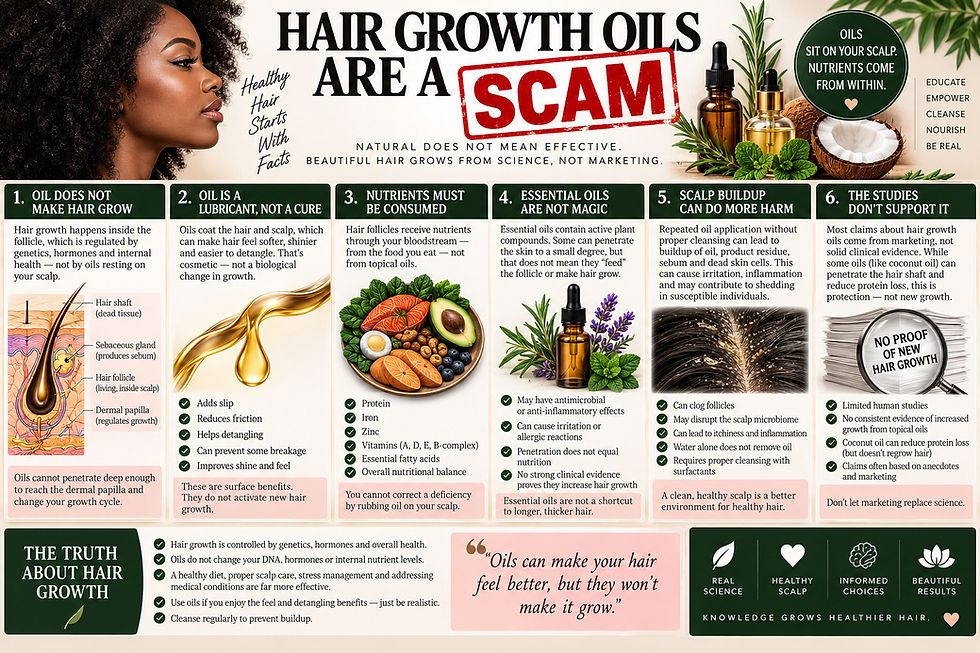
Hot oil treatments have been promoted for generations as a way to “feed,” “moisturize,” “nourish,” “strengthen,” and “repair” hair.
Coconut oil in particular has developed a reputation as a natural treatment capable of restoring damaged hair and improving scalp and follicle health.
But several very different biological processes are being grouped together under the word “nourishment.”
Hair lubrication is not hair repair.
Reducing protein loss is not replacing protein.
Oil is not moisture.
Skin absorption is not nutritional delivery.
And something that benefits the dead hair fiber does not automatically benefit the living scalp or follicle.
Understanding the difference requires looking separately at the hair shaft, scalp, hair follicle, coconut-oil chemistry, cleansing, and nutrition.

1. THE HAIR SHAFT IS DEAD KERATINIZED TISSUE
Hair is produced inside the living hair follicle. Rapidly dividing matrix cells differentiate, keratinize, harden, and ultimately form the hair shaft.
Once that shaft emerges from the scalp, it consists primarily of compact keratinized material rather than living tissue capable of biological healing.
That distinction immediately places limits on what any cosmetic oil can accomplish.
If cuticle material has been lost, an oil cannot grow a new cuticle.
If the fiber has been weathered by bleaching, chemical processing, heat, UV exposure, or mechanical manipulation, oil cannot make those dead structures regenerate.
If hair has split, oil may temporarily improve how that fiber looks and behaves, but it cannot biologically turn the damaged portion into newly grown hair.
Products can condition, coat, lubricate, and protect damaged hair.
That is different from healing it.
2. WHAT OIL ACTUALLY DOES WELL: LUBRICATION
One of the most straightforward benefits of applying oil to hair is physical lubrication.
Oil can coat the hair fiber and decrease friction between neighboring strands.
That creates slip.
More slip can make combing and detangling easier and decrease the mechanical stress produced by brushing, combing, and manipulating the hair.
That can be valuable.
Reducing friction may decrease additional cuticle wear and mechanical breakage.
But preventing additional damage is not the same thing as reversing existing damage.
The benefit is lubrication and protection—not biological repair.
The cosmetic result can still be impressive. Hair may appear smoother, shinier, and softer because the physical properties of its surface have changed.
Feeling repaired and actually being structurally regenerated are two different things.
3. OIL IS NOT MOISTURE
Another major misconception in hair care is describing oils as “moisturizing.”
Water is moisture. Oil is lipid.
Applying oil to hair does not directly add water to the fiber.
Hair interacts with environmental water, and the fiber can swell and contract as its water content changes. Hair-care research has examined repeated swelling and deswelling as one mechanism involved in hair damage.
Oil can influence the movement of water into and out of the fiber and can change the way the surface feels.
But that does not make the oil itself moisture.
This distinction matters when someone continually applies oil because their hair “feels dry.”
They may be repeatedly adding lipid to a fiber that needs appropriate hydration and conditioning, then interpreting temporary softness and reduced friction as additional moisture.
Those are not chemically identical processes.
4. HAIR ALREADY HAS A NATURAL OIL SYSTEM: SEBUM
The scalp contains sebaceous glands that produce sebum as part of the pilosebaceous unit.
Sebum naturally contributes lipids to both the scalp and hair.
How effectively sebum travels down the hair shaft varies according to hair length, curl pattern, grooming practices, washing habits, and individual sebum production.
For some people particularly those with long, curly, coily, or highly manipulated hair—additional conditioning or lubrication may improve manageability.
But that does not establish that everyone biologically needs plant oil applied directly to the scalp.
If the hair has already been hydrated and appropriately conditioned, and natural sebum is adequately lubricating the fiber, additional oil may simply provide another layer of lubrication and occlusion.
5. COCONUT OIL IS DIFFERENT—BUT NOT BECAUSE IT “REPAIRS” HAIR
There is legitimate research showing that coconut oil behaves differently from some other oils.
A 2001 study using secondary ion mass spectrometry found that coconut oil penetrated the human hair shaft whereas mineral oil did not.
Researchers proposed that coconut oil’s molecular characteristics and affinity for hair proteins contributed to this difference.
The researchers also found evidence suggesting that oil penetration could limit hair swelling.
A subsequent 2003 study compared coconut, sunflower, and mineral oils.
Coconut oil was the only one of the three that substantially reduced protein loss from damaged and undamaged hair under the conditions studied.
The researchers connected this behavior to coconut oil’s composition—particularly its lauric-acid-rich triglycerides, molecular characteristics, straight-chain structure, and affinity for hair proteins.
That is an important finding.
But it is frequently translated into something the research did not establish:
Reducing protein loss is not the same thing as replacing lost protein.
Coconut oil does not insert new keratin where the hair’s structure has already been destroyed.
It does not regenerate missing cuticle cells.
It does not transform chemically compromised hair back into virgin hair.
Its demonstrated benefit is better understood as helping protect existing material from additional loss under certain conditions.
That is protection not regeneration.
6. THE LAURIC-ACID STORY NEEDS MORE PRECISION
People frequently say, “Lauric acid penetrates the hair.”
Chemically, the situation is more complicated.
Coconut oil is rich in fatty acids, particularly lauric acid, that are predominantly present esterified within triglycerides.
The characteristics of these lauric-rich triglycerides help explain coconut oil’s unusual interaction with the hair fiber.
Coconut oil is not supplying protein to the hair.
It is not “feeding” keratin.
Its chemistry allows components of the oil to interact differently with the hair fiber than certain other oils.
That interaction can help reduce protein loss under specific conditions.
Again:
Protecting existing protein does not mean manufacturing or replacing protein.
7. PENETRATING THE HAIR FIBER DOES NOT MEAN “FEEDING” THE HAIR FOLLICLE
This is one of the most important distinctions.
The hair shaft and hair follicle are fundamentally different structures.
The hair shaft is keratinized material.
The follicle is a living mini-organ containing multiple epithelial and mesenchymal structures involved in producing and regulating hair growth.
The fact that coconut oil can penetrate a dead keratinized hair fiber does not establish that coconut oil travels through the scalp in nutritionally meaningful quantities and “feeds” the living cells responsible for producing hair.
Those are completely different biological processes.
8. WHAT HAPPENS WHEN COCONUT OIL IS PUT ON THE SCALP?
The scalp is living skin.
Its outermost barrier the stratum corneum—is specifically designed to regulate movement of substances between the body and the outside environment.
Oil placed on that surface can coat the scalp, hair, natural sebum, and superficial corneocytes.
At the same time, scalp skin is continuously undergoing normal cell turnover and desquamation.
The important distinction is between cell turnover and physical clearance.
Applying oil does not necessarily stop epidermal cells from completing their normal turnover and detaching.
But detached material still has to be physically cleared from the scalp.
That distinction becomes especially important when heavy oils and styling products are continually reapplied without adequate cleansing.
9. SHED SKIN + SEBUM + OIL + PRODUCT CAN ACCUMULATE
Normal cleansing is not simply about making hair smell clean.
Shampoo is designed to help remove substances including sebum, sweat, desquamated stratum-corneum cells, styling-product residue, and environmental debris from the scalp and hair.
Now consider someone who repeatedly applies coconut oil, creams, butters, and other lipid-rich products to the scalp while primarily performing water rinses.
The scalp can potentially accumulate a mixture of:
Applied oil + natural sebum + shed corneocytes + sweat + styling-product residue.
Then another layer of product is applied.
And another.
The skin cells have not necessarily stopped shedding.
Efficient removal of the shed material can become the problem.
Oil does not “rehydrate” those dead cells because oil is not water.
Instead, lipids and products can coat and soften superficial material and keep it incorporated within an oily/product film that remains on the scalp.
10. WATER ALONE IS POOR AT REMOVING HEAVY OIL DEPOSITS
Sebum and oils are not readily soluble in water.
That is one reason cleansing products contain surfactants.
Surfactants contain regions that interact with oily material and regions that interact with water. This allows oily material to be emulsified and carried away during cleansing and rinsing.
Simply running water over heavily oiled hair is therefore not chemically equivalent to cleansing that oil away.
This becomes particularly relevant when someone applies coconut oil or other heavy products to the scalp every day.
The cycle can become:
Oil → sebum → shed skin → product residue → inadequate removal → more oil → more accumulation.
11. CO-WASHING IS NOT THE SAME AS WATER WASHING—BUT FORMULATION MATTERS
It would be inaccurate to say that every co-wash is incapable of cleansing.
Cleansing conditioners vary significantly.
Some contain mild surfactants capable of removing some oil and soil.
Others prioritize conditioning and have substantially less cleansing ability than conventional shampoos.
So the relevant question is not simply:
“Do you co-wash?”
The better question is:
“Is your cleansing system capable of removing the amount and type of material you are repeatedly depositing?”
Someone using a small amount of styling product has very different cleansing requirements from someone saturating the scalp with coconut oil every day.
12. COCONUT OIL CAN CHANGE THE SCALP MICROBIOME
Scalp oil should not automatically be considered biologically inert.
A 2021 longitudinal study involving 140 Indian women with healthy or dandruff scalps examined how coconut oil affected bacterial and fungal scalp populations.
Coconut-oil treatment changed several microbial populations, including organisms belonging to Malassezia and Cutibacterium.
Importantly, the researchers interpreted several of these changes as potentially beneficial rather than harmful.
That prevents us from making an unsupported blanket claim that coconut oil automatically creates an unhealthy microbiome.
However, there is an extremely important detail about that study.
Researchers were not studying daily coconut-oil accumulation combined with inadequate cleansing.
Participants in the coconut-oil groups received approximately 10 mL of coconut oil twice weekly, followed by a two-hour leave-on period and then shampooing.
That treatment continued for 12 weeks.
That is substantially different from:
Daily oil + repeated product layering + water rinsing + inadequate removal.
Evidence showing certain microbiome effects from controlled coconut-oil application followed by shampooing cannot automatically be applied to continual daily layering without adequate cleansing.
They are different exposure conditions.
13. BUILDUP AND INFLAMMATION MUST BE SEPARATED FROM PROVEN HAIR-LOSS CAUSATION
This is where professional observation and established scientific evidence need to be distinguished.
A stylist or scalp professional may repeatedly encounter clients who heavily oil their scalps, inadequately cleanse them, and present with significant adherent buildup, irritation, itching, inflammation, breakage, shedding, or thinning.
Those observations matter.
But they do not independently prove:
Coconut oil → follicle destruction → permanent baldness.
Hair loss and apparent thinning can have many causes, including breakage, traction, seborrheic dermatitis, folliculitis, androgenetic alopecia, inflammatory or scarring alopecias, nutritional deficiencies, medications, hormonal changes, and other medical conditions.
The more scientifically defensible concern is:
Repeated heavy oil/product deposition + inadequate cleansing → accumulation of lipids, product residue, sebum, and shed material → altered scalp environment → possible irritation and inflammation in susceptible individuals.
Whether that process caused a particular person’s hair loss requires proper evaluation.
14. ESSENTIAL OILS DO NOT TURN CARRIER OIL INTO “FOOD FOR THE FOLLICLE”
Another common practice is adding rosemary, peppermint, lavender, or other essential oils to coconut, castor, olive, or another carrier oil and describing the mixture as “nutrition” for the follicle.
That explanation is biologically misleading.
Essential oils primarily contain concentrated volatile plant compounds, including numerous terpenes and terpenoids.
It is also important to correct another misconception:
It is not scientifically accurate to say essential oils cannot penetrate human skin.
Different essential-oil components can penetrate the stratum corneum to different degrees depending on their molecular characteristics, concentration, formulation, exposure time, and the condition of the skin.
Some terpenes have actually been investigated as penetration enhancers for topical drug delivery.
But that leads to an extremely important distinction:
Penetration is not nutrition.
15. SKIN ABSORPTION AND NUTRITIONAL DELIVERY ARE DIFFERENT PROCESSES
Suppose a component of an essential oil penetrates the stratum corneum.
That does not mean:
“The hair follicle just ate that ingredient.”
A topically applied compound may remain within superficial skin, enter deeper layers, undergo local metabolism, interact with receptors or microorganisms, reach systemic circulation in varying amounts, or eventually be metabolized and eliminated.
That is pharmacology and pharmacokinetics.
It is not the same process as nutrition.
16. HAIR FOLLICLES RECEIVE NUTRITIONAL SUPPORT THROUGH THE BODY
Living cells within and surrounding the follicle are metabolically active.
Nutritional deficiencies involving protein/calorie intake, iron, zinc, and certain vitamins and minerals can be associated with hair-growth abnormalities.
But obtaining those nutrients requires an entirely different physiological pathway.
Food is consumed.
It is digested.
Nutrients are absorbed through the gastrointestinal system.
They enter circulation or lymphatic transport.
The body metabolizes, regulates, stores, and distributes them.
Living tissues then receive available substrates through their physiological blood supply and surrounding environment.
Therefore, applying a plant oil containing a particular compound to the scalp is not nutritionally equivalent to consuming an adequate diet containing nutrients the body can digest, absorb, and distribute.
You cannot correct inadequate protein intake by painting protein onto the scalp.
You cannot correct iron deficiency by rubbing an iron-containing substance onto your head.
And adding essential oils to carrier oil does not transform that mixture into nutritional delivery for the hair follicle.
Nutrition and topical treatment are different biological processes.
17. TOPICAL INGREDIENTS CAN STILL HAVE BIOLOGICAL EFFECTS
None of this means topical ingredients cannot affect living skin.
They absolutely can.
A topical compound may potentially influence microorganisms, receptors, inflammatory pathways, skin-barrier function, blood vessels, or other biological processes.
That is why certain medications can be delivered topically.
But that would represent a local pharmacological or biological effect—not feeding the follicle.
This distinction also explains why “natural” does not automatically mean harmless.
Essential oils contain biologically active chemicals.
Depending on the substance and concentration, they can also cause irritation or allergic contact dermatitis in susceptible individuals.
18. WHAT DOES HEATING THE OIL ACTUALLY ADD?
Now we return to the original question:
What exactly does a hot oil treatment accomplish that requires the oil to be hot?
Heating coconut, olive, castor, or another oil does not make the dead hair shaft biologically alive.
It does not regenerate missing cuticle cells.
It does not manufacture keratin.
It does not replace protein that has already been lost.
It does not convert lipid into water.
It does not transform oil into dietary nutrition.
And it does not make the follicle “eat” the oil.
The most immediately noticeable effects remain primarily cosmetic:
Lubrication.
Slip.
Reduced friction.
Easier detangling.
Smoother feel.
Increased shine.
Those are real benefits.
But they do not require us to call the treatment “healing” or “repairing.”
Coconut oil has the additional experimentally supported ability to penetrate the hair fiber and reduce protein loss under certain conditions.
That is a legitimate protective property.
It is still not biological repair.
19. SALON REALITY MATTERS TOO
Laboratory findings also need to be considered alongside real-world product use.
A controlled amount of coconut oil applied under experimental conditions is very different from a client repeatedly saturating the hair and scalp with it.
In professional salon practice, heavily oiled hair can become difficult to cleanse and may feel greasy, heavy, coated, or limp.
Removing excessive oil may require repeated cleansing or stronger surfactant systems.
Stronger cleansing has its own tradeoffs because excessive removal of lipids can leave hair rougher, drier-feeling, and more difficult to manage.
That can create a frustrating cycle:
Over-application of oil → difficult removal → more aggressive cleansing → increased need for conditioning → more products applied.
More product does not automatically equal healthier hair.
20. SO ARE HOT OIL TREATMENTS COMPLETELY USELESS?
No.
They can be useful as lubricating treatments.
If oil provides enough slip to allow someone to safely detangle long, highly textured, curly, coily, or tangled hair using less mechanical force, that is a legitimate benefit.
Reduced friction may mean less unnecessary manipulation and potentially less breakage.
But we do not need to turn that benefit into something it is not.
A product can be useful without claiming that it:
Repairs dead tissue.
Rebuilds missing keratin.
Regenerates damaged cuticle.
Supplies water to the hair.
Feeds the follicle.
Corrects nutritional deficiencies.
Or makes damaged hair biologically healthy again.
21. THE BIGGER PROBLEM IS THE LANGUAGE
Much of the confusion surrounding oils comes from marketing terminology:
“Nourishing.”
“Feeding.”
“Repairing.”
“Restoring.”
“Moisturizing.”
These words make completely different physical and biological processes sound interchangeable.
They are not.
A more scientifically accurate description is:
Oil primarily changes the physical behavior of the hair fiber by providing lubrication, reducing friction, influencing water movement, and in the case of certain oils such as coconut oil potentially penetrating the fiber and reducing subsequent protein loss.
That is already a meaningful benefit.
We do not need to call lubrication “healing.”
We do not need to call lipid “moisture.”
And we do not need to call topical application “nutrition.”
THE BOTTOM LINE
Hair fibers and hair follicles have to be discussed separately.
The hair shaft is dead keratinized material. Cosmetic products can alter its surface, friction, water interactions, manageability, and appearance, but they cannot make dead tissue biologically regenerate.
Coconut oil is unusual among commonly used oils. Its lauric-rich triglycerides can penetrate the hair fiber, and controlled studies have demonstrated reduced protein loss. That represents a potentially useful protective effect—not replacement of lost protein or regeneration of damaged hair.
The scalp is living skin. Continually applying heavy oils while inadequately cleansing can leave applied oil, natural sebum, product residue, sweat, and shed corneocytes on the scalp. Water alone is not an efficient cleanser for large amounts of hydrophobic material, which is one reason surfactants are used in cleansing products.
Coconut oil can alter the scalp microbiome, but current research does not establish that those changes are inherently harmful. One major study actually reported changes the investigators considered favorable. Importantly, that study involved controlled coconut-oil application followed by shampooing not indefinite daily layering without adequate cleansing.
Essential-oil components can penetrate human skin to varying degrees. Therefore, saying that nothing applied to the scalp can enter the skin or circulation is inaccurate. But skin penetration is not the same thing as nutritional delivery to the follicle.
Hair follicles receive nutritional support through human physiology. If someone has an actual nutritional deficiency affecting hair growth, correcting that deficiency requires making the nutrient appropriately available to the body generally through diet or medically appropriate supplementation not simply applying an oil containing that compound to the scalp.
And finally:
The strongest everyday benefit of an oil treatment is much simpler than the marketing suggests:
lubrication.
Oil can provide slip.
Oil can make detangling easier.
Oil can reduce friction.
Oil can make the hair feel smoother.
Oil can temporarily improve shine and manageability.
And coconut oil may reduce additional protein loss under certain conditions.
Those are legitimate cosmetic and protective effects.
But coating, lubricating, and protecting a hair fiber are not the same thing as repairing, moisturizing, feeding, or healing it.
RESEARCH AND REFERENCES
Rele AS, Mohile RB. Effect of mineral oil, sunflower oil, and coconut oil on prevention of hair damage. Journal of Cosmetic Science. 2003;54(2):175–192.
Ruetsch SB, Kamath YK, Rele AS, Mohile RB. Secondary ion mass spectrometric investigation of penetration of coconut and mineral oils into human hair fibers: relevance to hair damage. Journal of Cosmetic Science. 2001.
Saxena R, et al. Longitudinal study of the scalp microbiome suggests coconut oil to enrich healthy scalp commensals. Scientific Reports. 2021;11:7220.
Herman A, Herman AP. Essential oils and their constituents as skin penetration enhancer for transdermal drug delivery: a review. Journal of Pharmacy and Pharmacology. 2015;67(4):473–485.
Cal K. Skin penetration of terpenes from essential oils and topical vehicles. Planta Medica. 2006.
Gavazzoni Dias MFR. Hair Cosmetics: An Overview. International Journal of Trichology. 2015.
D’Souza P, Rathi SK. Shampoo and Conditioners: What a Dermatologist Should Know? Indian Journal of Dermatology. 2015.
Almohanna HM, et al. The Role of Vitamins and Minerals in Hair Loss: A Review. Dermatology and Therapy. 2019.


Comments