
She Hated My Hair Advice Until She Realized I Was Right 10 Years of Damage
I received an email that I want to share with you because it explains exactly why I've spent the last five years educating women about hair care.
This woman has never paid me a dime. She didn't purchase a consultation, a product, or a service. She simply watched my videos and eventually made changes that she believes transformed her life.
What's interesting is that she initially disagreed with me. She had already spent ten years following advice she believed was protecting her hair.
I want you to hear her experience in her own words because there's a much bigger lesson here about misinformation, education, and the consequences of blindly following advice.
THE VIEWER'S COMPLETE ORIGINAL EMAIL
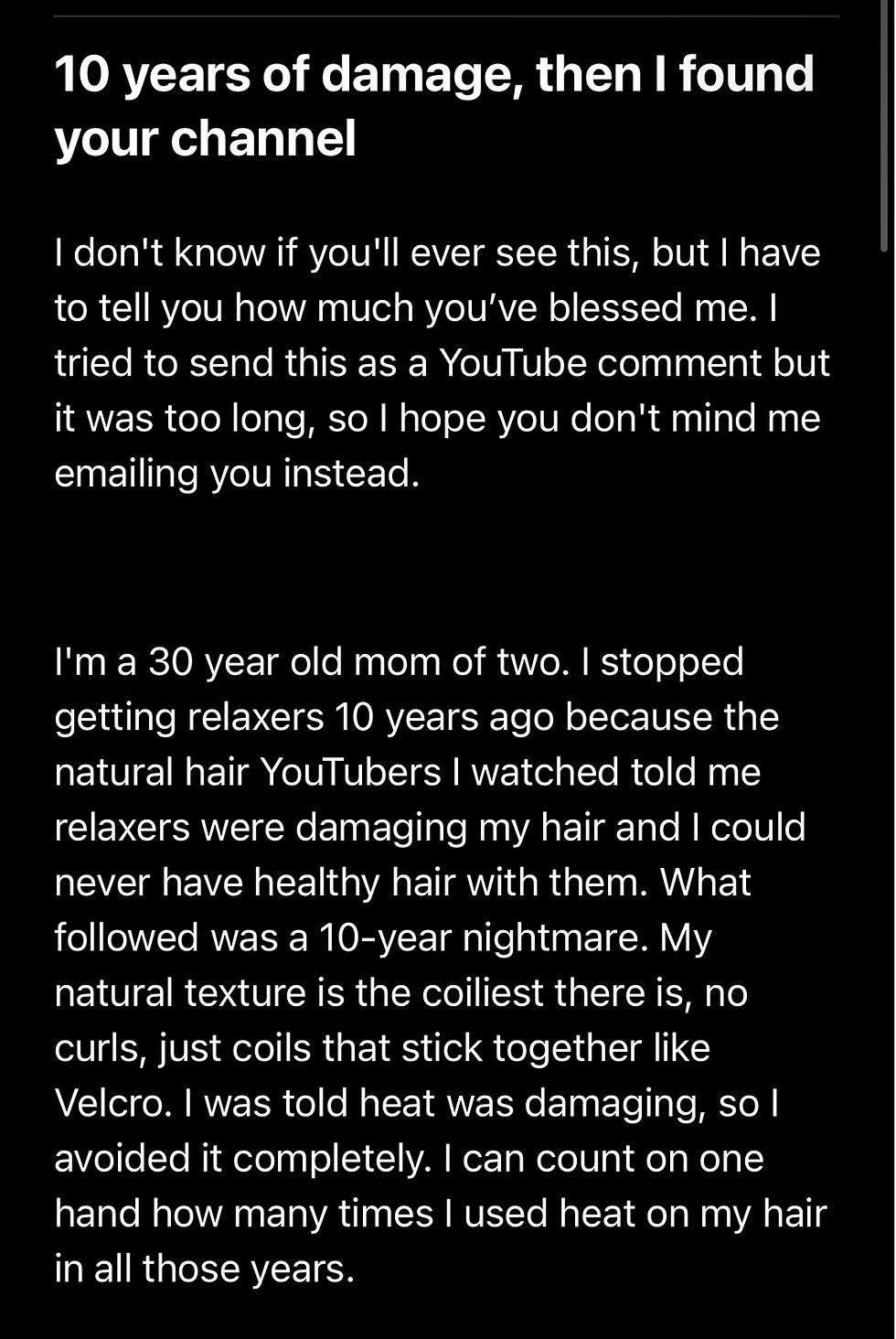
I don't know if you'll ever see this, but I have to tell you how much you’ve blessed me. I tried to send this as a YouTube comment but it was too long, so I hope you don't mind me emailing you instead.
I'm a 30 year old mom of two. I stopped getting relaxers 10 years ago because the natural hair YouTubers I watched told me relaxers were damaging my hair and I could never have healthy hair with them. What followed was a 10-year nightmare. My natural texture is the coiliest there is, no curls, just coils that stick together like Velcro. I was told heat was damaging, so I avoided it completely. I can count on one hand how many times I used heat on my hair in all those years.
For my birthday one year, I treated myself to a silk press at what was supposed to be the top salon in my city. I booked the owner specifically because I wanted the best. She took one look at my texture and apparently assumed I needed maximum heat, and she burned the front section of my hair completely off with a hot comb. I watched it fall to the floor while she apologized in shock, saying she'd never done that before, and offered to take $25 off. Looking back, I should have stood up for myself a lot more, but because I hadn't been to the salon in years and I was kind of embarrassed about the whole thing, I just said "it's okay." Two weeks later, when water hit my hair, all I smelled was burnt. It was completely heat damaged. I told myself I'd never go to a salon again.
So I kept following the natural hair influencers. I did everything I now know not to do. I was adding eggs, mayonnaise, and oils to conditioners as protein treatments, sleeping with conditioner in my hair, wetting my hair to detangle, avoiding combs and brushes, piling on products thinking more was better, letting my hair air dry every single time because I thought a blow dryer's heat would damage it not knowing I was contributing to hygral fatigue, and leaving my hair in braids for 3 months at a time thinking it was protective. One day I looked at my hair and every single strand had a knot, some had three. Even though my hair reached mid back length, the last 8 inches from the ends up were completely see through and thin. The shed hair from 3 months of braids had locked onto my strands, and detangling with water only made it worse. I broke down crying. I told myself I either had to cut it all off or get a relaxer.
I got the relaxer, but it didn't fix everything, because the techniques I'd been taught were still stuck in my head. They were all I knew.
Then one day your video showed up in my algorithm. Honestly, I was uncomfortable and a little angry, because everything you said contradicted what I'd been taught. My first thoughts were, "She doesn't know what she's talking about," "She's just hating on the natural hair YouTubers," and "If their advice is so bad, why is their hair long and hers short?" But days later, another video of yours popped up, and I clicked out of curiosity. When you explained things scientifically, it started to ring true. I did my own research, and you were 100% correct. Everything clicked. It was like going from blindness to 20/20 vision.
I believe your videos get suppressed because they want to keep people in a cycle of over consumption, believing some magical product will transform their hair, so they keep buying and buying. Now that I have this information, I've completely shifted my perspective. I can research and figure out what works for me instead of relying on false information. I love that you don't give a step by step list. You just tell people what to stop doing, because honestly, stopping is enough to get your hair on a healthier path.
I want you to know you didn't just change my life, and yes, I mean my life. For a woman, hair is her crown and glory. You changed my daughter's life, my mother's life, my son's life, and everyone else whose hair I touch. I'm implementing what you taught into all of our routines. The negative comments come from ignorance. People fear what they don't know, so they go on the defense. Please keep doing what you do. I truly believe you were sent by God to help people, and I couldn't rest without telling you that there are people out here who appreciate you more than you know.
THIS IS WHY I DO WHAT I DO
Now, there are several things in this email that I want to address because this woman's experience represents a much bigger problem within the hair-care community.
She spent ten years following advice she trusted, yet her hair continued to deteriorate.
And here's what concerns me.
She wasn't neglecting her hair.
She was actively trying to care for it. She invested time, money, and effort into techniques she believed were beneficial.
This is why popularity should never be confused with scientific accuracy.
When information is repeated often enough, people stop questioning it. It becomes accepted as fact, even when the explanation behind it is incomplete or misleading.
1. THE FEAR OF HEAT
One of the first things that stood out was her fear of heat.
She avoided it for nearly a decade because she believed any exposure would damage her hair.
But heat isn't automatically destructive. Temperature, technique, frequency, and the condition of the hair all matter.
Unfortunately, when she finally visited a professional, she experienced severe heat damage.
That experience reinforced the very fear she'd developed.
And this is an important distinction: improper heat application and controlled heat styling are not the same thing.
A professional's reputation doesn't guarantee proper technique. Understanding how and when to use heat is what matters.
2. WHEN HAIR-CARE TECHNIQUES BECOME THE PROBLEM
Now, look at everything she described doing to her hair.
Homemade protein treatments, overnight conditioning, excessive product layering, avoiding certain detangling tools, and leaving braids installed for months.
She believed these practices were protecting her hair.
But hair-care techniques have to be evaluated individually. What works under one set of conditions may cause problems under another.
And here's something I really want women to understand.
She said her hair reached mid-back length, yet the last eight inches were thin and see-through.
Long hair does not automatically mean healthy hair.
Length is only one measurement. The condition of the ends, breakage, density, and overall integrity of the hair matter too.
You cannot determine whether someone's hair-care advice is scientifically accurate simply by looking at how long their hair is.
3. A RELAXER CANNOT CORRECT BAD HABITS
Another statement that stood out was when she admitted that getting a relaxer didn't solve everything.
Why?
Because she continued using the same techniques she'd learned while wearing her hair natural.
And this is an important lesson for both natural-haired and relaxed-haired women.
Changing the chemical structure of your hair doesn't automatically correct problems caused by inappropriate maintenance practices.
A relaxer changes the hair's structure. It doesn't replace the need for proper care.
The foundation of a successful hair-care routine is understanding the hair you're working with.
4. RESEARCH VS. DEFENDING WHAT YOU BELIEVE
Now, THIS is probably the most important part of her entire email.
She admitted that when she first discovered my channel, she was uncomfortable, angry, and convinced I didn't know what I was talking about.
Why?
Because what I was teaching contradicted information she'd believed for ten years.
She assumed I was attacking natural hair influencers, and she even questioned my credibility because my hair was shorter than theirs.
And that's something I see constantly in my comment section.
People will judge someone's knowledge based on their appearance, popularity, or whether they agree with their favorite influencer.
But let me explain something.
Hair length is not an educational credential, and popularity is not scientific evidence.
Having long hair doesn't automatically qualify someone to teach hair science, just like having short hair doesn't disqualify someone from understanding it.
And this is where her story becomes important.
Instead of remaining defensive, she became curious.
She watched another video, listened to the explanation, and decided to investigate the information herself.
And according to her, that's when everything started making sense.
Notice what changed.
It wasn't my appearance.
It wasn't my delivery.
And it wasn't because I convinced her to blindly believe me.
She stopped evaluating the messenger and started evaluating the information.
THAT is what education is supposed to encourage.
And I want people to understand something else.
You can believe something for ten, fifteen, or even twenty years and still be wrong about it.
The length of time you've believed something doesn't determine whether it's scientifically accurate.
And being willing to change your position when presented with credible evidence isn't weakness. It's intellectual growth.
I don't expect everybody to agree with me. But if you're going to challenge information, challenge it with evidence.
Not emotions. Not appearances. And not somebody else's subscriber count.
Because defending what you've been taught and understanding what you've been taught are two completely different things.
The goal isn't to win an argument. The goal is to understand what's actually true.
5. THE BUSINESS OF OVERCONSUMPTION
She also raised an issue that deserves attention: the constant cycle of buying hair products.
Think about how much money women spend searching for solutions.
A new conditioner. Another oil. A different treatment. Another product promising longer, stronger, healthier hair.
But if the underlying problem involves technique, adding another product may accomplish very little.
This is why I focus so much on helping women understand what they're doing rather than constantly recommending something new to purchase.
Not every hair problem requires another product.
Sometimes the most beneficial change is recognizing which practices are unnecessary or aren't producing the desired results.
Education should make you a more informed consumer, not a more dependent one.
6. THE IMPACT GOES BEYOND ONE PERSON
Now, this is the part of the email that means the most to me.
She said the information didn't just affect her.
It influenced how she cares for her daughter's hair, her mother's hair, her son's hair, and the hair of others around her.
And that is why sharing accurate, useful information matters.
When one person develops a better understanding of something, that knowledge can benefit an entire family.
This woman accessed my educational content for free.
She didn't have to purchase anything to begin questioning the techniques she'd followed for years.
And now she's applying what she's learned beyond herself.
That's the kind of impact that makes the work worthwhile.
I want to thank this woman for taking the time to share her experience.
Her email is a reminder that the value of educational content isn't always reflected in views, likes, subscriber counts, or sales.
Sometimes its impact is found in someone quietly watching, learning, and applying what they've discovered.
And you may never know that person exists until they send you a message like this.
That's why I've continued having these conversations for the last five years, even when the information has been unpopular or challenged.
I'm not here to tell women what hairstyle they should wear or which influencer they should follow.
I'm here to encourage a better understanding of hair care so women can make informed decisions instead of relying on misinformation, fear, or marketing.
And if that information helps someone avoid years of frustration, unnecessary spending, or damaging practices, then the time I've invested in educating people has been worthwhile.
To the woman who sent this email, thank you for trusting me with your story.
And to everyone watching, I have a question.
What's one piece of hair-care advice you followed for years before realizing it wasn't working for you?
I want you to share your experience in the comments, because conversations like these may help somebody who's currently going through the same thing.
This is bigger than hair. It's about knowledge, independent thinking, and understanding the difference between what you've been told and what you can actually support with evidence.
And THAT is why I do what I do.


Comments