
Softee Hair Grease, Lanolin & Black Hair: Why I Question What Years of Greasing the Scalp May Have Done
“Before we start, I need you to think about one question: what if something we were taught was ‘feeding,’ ‘moisturizing,’ and helping our hair grow was actually doing something completely different?
For generations, Black families greased the scalp. Our mothers did it. Our grandmothers did it. Men used heavy pomades while brushing their 360 waves. And products like Softee became part of our hair culture.
But tonight, we’re turning the jar around.
We’re talking about lanolin the wool wax that comes from sheep. Where does it come from?

How is it processed? Why is it combined with ingredients like petrolatum? What does it actually do to the hair? And what happens when heavy pomades are repeatedly applied to the scalp for years?
I’m also going to talk about something I believe deserves far more research: the relationship between old-school wave routines, heavy pomade use, scalp health, and the hair loss we’re seeing in many Black men today.
Now, I want to be clear: I’m not going to tell you science has proven lanolin causes male-pattern baldness, because it hasn’t. But I am going to show you why I’m asking the question.
This isn’t about disrespecting our mothers, fathers or grandparents. It’s about understanding what they were given, what they were told, and what we know now.
So grab your old jar of hair grease, turn that ingredient label around, and let’s talk about what we’ve really been putting on our hair and scalp.
Welcome to the deep dive into Softee Hair Grease and lanolin.”
For generations, hair grease was practically a fixture in Black households.
It sat next to the combs, brushes, rollers, pressing combs and hair ties. Mothers greased their children's scalps. Women used it before styling. Men used pomades and hair dressings to create waves, slick styles and polished cuts.

For many of us, grease wasn't considered an occasional styling product. It was hair care.
And products such as Softee Hair Food became part of that tradition.
Today, however, I'm looking at these products differently.
The deeper I examine ingredients such as lanolin, petrolatum, mineral oil and paraffin, the more questions I have about the practice of repeatedly coating the scalp with heavy hair dressings especially when that routine was continued for years.
I want to make my position clear from the beginning:
I do not support routinely greasing the scalp with heavy lanolin- and petrolatum-based products.
I also believe we need much more research into the long-term grooming practices historically used by Black men and women—including men who maintained 360 waves.
I have observed something that concerns me: many men who spent years using heavy pomades, brushing extensively and compressing their hair with durags later experience significant thinning.
I believe that relationship deserves investigation.
But observation is not the same as scientific proof. Current evidence does not establish lanolin, petrolatum or wave pomades as the cause of most male-pattern baldness.
That distinction is important because I want this conversation to challenge old practices without turning a hypothesis into a medical fact.

What Is Actually Inside Softee Hair Food?
The ingredient list immediately explains why this product behaves like traditional hair grease.
One current 5-ounce Softee Hair Food listing gives the formula beginning with:
White Petrolatum USP, Lanolin, Wheat Germ Oil, Tocopheryl Acetate and Soybean Oil, followed by numerous botanical extracts, BHT, fragrance components and Yellow 11.
Interestingly, another package/listing shows an older or alternative declaration:
Petrolatum, mineral oil, lanolin, wheat germ oil, tocopheryl acetate, paraffin, followed by the herbal complex, fragrance, BHT and Yellow 11.
That means formulations or labeling have apparently varied, so we shouldn't pretend every Softee Hair Food jar from every era contained precisely the same ingredient declaration.
But the bigger formulation story is obvious.
This is an oil-and-wax-rich hair dressing.
The herbal extracts might look impressive on the package, but the physical behavior of the grease is largely determined by ingredients such as petrolatum and lanolin.
Let's Talk About Lanolin
Lanolin has one of those cosmetic names that hides how interesting the ingredient actually is.
It comes from sheep's wool.
Calling it simply “sheep fat,” however, isn't chemically precise.
Lanolin is a purified secretion from sheep sebaceous glands that becomes deposited onto wool. It consists largely of complex long-chain waxy and sterol esters and is consequently also called wool wax or wool grease. (PubChem)

Think about what sheep wool has to endure.
Rain.
Moisture.
Cold.
Dirt.
Environmental exposure.
The waxy coating associated with wool helps protect it.
Humans figured out that those water-resistant, lubricating properties could also be useful in ointments, cosmetics and hair products.
That's how something produced naturally by a sheep ends up in a jar on your dresser.
How Lanolin Goes From Sheep to Hair Grease
Lanolin doesn't come straight off a sheep ready for cosmetic use.
After sheep are shorn, their wool is processed and washed. Wool wax can be recovered during this scouring process and subsequently separated and refined.
Commercial cosmetic or pharmaceutical lanolin is therefore a purified material, not simply dirty grease scraped off raw wool. PubChem describes commercial lanolin as refined wool wax derived from sheep sebaceous secretions deposited on wool fibers. (PubChem
In simplified form:
SHEEP → WOOL → SCOURING/WASHING → WOOL GREASE RECOVERY → SEPARATION → REFINING → LANOLIN
And now we have the yellow waxy substance used in cosmetics.
Why Would Anyone Put Lanolin on Hair?
Because lanolin actually has useful cosmetic properties.
It's an emollient.
It's hydrophobic.
It can lubricate.
It can make surfaces feel softer.

And it can help reduce water loss by forming a protective film. (PubChem)
That's important because I don't want to turn this discussion into:
“Lanolin comes from sheep, therefore lanolin is bad.”
That isn't science.
Plenty of useful cosmetic ingredients come from unusual natural or industrial sources.
The real question is:
What does the finished ingredient do when repeatedly applied to human hair and scalp?
That's where this gets interesting.

Lanolin Does Not Add Water to Your Hair
One of the biggest misunderstandings surrounding traditional hair grease is the word moisture.
Lanolin isn't water.
Petrolatum isn't water.
Mineral oil isn't water.

An occlusive ingredient can help slow the loss of water already present.
That's different from supplying water.
Think about putting a lid on a container.
The lid can prevent what's inside from evaporating.
But the lid didn't create the water.
That's why hair can feel slick, soft and shiny after applying grease while still leaving us with a different question about the actual water content of the fiber.
Shine is not automatically hydration.
And lubrication isn't automatically moisture.
Why Hair Grease Makes Hair Look So Good
This is exactly why these products survived for generations.
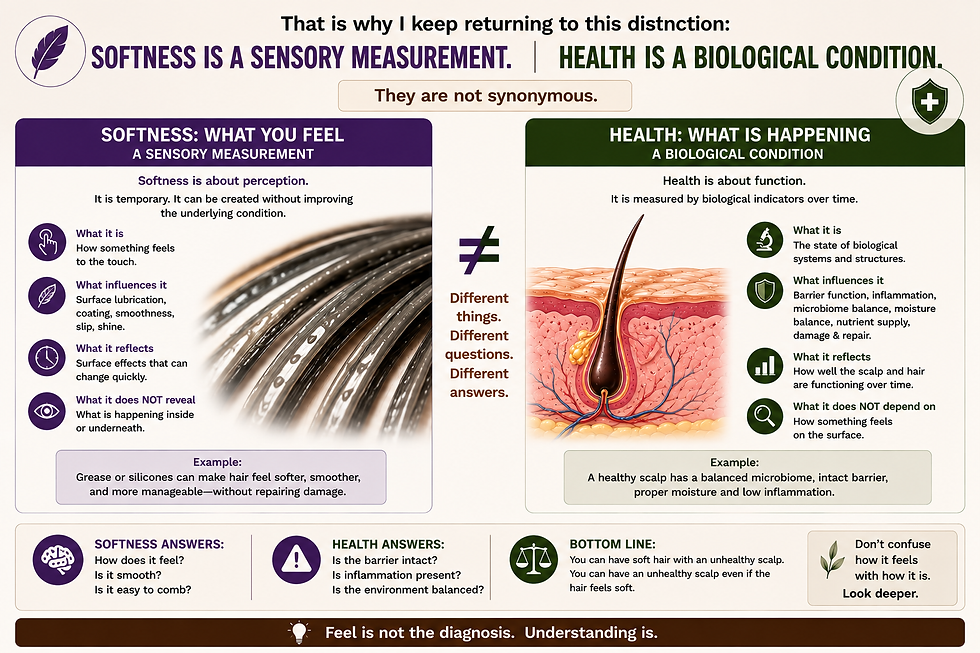
They work cosmetically.
Put grease on dull hair and suddenly the hair may appear:
darker, smoother, shinier, softer and more controlled.That's not imaginary.
Coating the hair fiber changes its surface.
Lubrication can reduce friction between strands. A smoother surface can reflect light differently. Flyaways can become controlled. Hair can feel softer when touched.
Those are legitimate benefits.
But we need to distinguish:
COSMETIC APPEARANCE
from
BIOLOGICAL HAIR GROWTH
and
INTERNAL HAIR HYDRATION.
They're not the same thing.
Softee Wasn't Necessarily Meant Only for the Hair
This part of the story is particularly important.
People sometimes respond to scalp-grease concerns by saying:
“Well, you're not supposed to put it on your scalp.”
Except Softee's directions tell a more complicated story.
One current Hair Food listing says that for regular use it should be applied to the hair before styling.
But its special-treatment instructions explicitly tell consumers to apply it generously to the hair AND scalp, cover the hair with a plastic cap, wrap it with a hot moist towel, repeat the process and then shampoo. (Instacart)
So direct scalp application wasn't necessarily consumers misusing the product.
It was actually instructed.
That changes the historical conversation.
Generations of consumers weren't simply inventing the practice of greasing the scalp.
The beauty industry helped normalize it.
And This Is Where I Start Asking Questions
The scalp isn't the same thing as the hair fiber.
Your hair fiber is keratinized tissue.
Your scalp is living skin containing follicles, sebaceous glands, blood vessels, immune activity and a microbial ecosystem.
So I'm far more cautious about what we repeatedly apply directly to the scalp.
Putting a lubricating coating on a hair strand and repeatedly covering living scalp skin with a heavy pomade are two different things.
And dermatology actually gives us a historical reason to take that distinction seriously.
Pomade Acne Was Documented Decades Ago
In 1970, researchers examined 735 Black men regarding their daily use of scalp creams and oils.
Their findings are extraordinary in the context of this conversation.
About 70% of long-term pomade users in that particular study displayed a recognizable acne-like eruption involving the forehead and temples. The lesions were predominantly closed comedones, with occasional inflammatory lesions. (JAMA Network)
Researchers also applied five pomades under continuous occlusion for eight weeks and found microscopic evidence of early comedone formation. (JAMA Network)
Later dermatological literature discussing acne in ethnic skin specifically notes that thick hair emollients implicated in pomade acne commonly contained mixtures of:
petrolatum + lanolin + mineral, vegetable or animal oils. (PubMed Central (PMC))
Read that again.
This isn't a TikTok theory from 2026.
Dermatologists were documenting pomade-associated follicular plugging more than 50 years ago.
But Pomade Acne Is NOT the Same Thing as Baldness
This distinction may be the most important sentence in this entire article.
Finding evidence that a pomade can contribute to comedones does not prove that the same product permanently destroys the hair follicle.
A clogged follicular opening and androgenetic follicular miniaturization are not interchangeable biological processes.
Androgenetic alopecia—pattern hair loss—involves progressive miniaturization of susceptible follicles. (PubMed)
Therefore, I cannot scientifically say:
“Softee caused Black men to go bald.”
I can't say:
“Lanolin is why most men are bald.”
And I can't say:
“Petrolatum destroys hair follicles.”
Those conclusions haven't been demonstrated.
But that doesn't end my questions.
It creates a better question.

What About Black Men Who Had 360 Waves?
This is the group I believe deserves considerably more research.
Think about the traditional wave routine.
A man might apply pomade or grease.
Brush.
Brush again.
Brush repeatedly.
Apply more product.
Compress the hair with a durag.
Sleep in it.
Repeat the process.
And maintain that routine for years.
That potentially introduces several variables simultaneously:
product exposure + repeated brushing + compression + friction + sweat + cleansing frequency + individual scalp biology + genetic susceptibility to pattern hair loss.
So when we later see thinning at the hairline or crown, I don't think the scientifically responsible approach is to automatically blame one ingredient.
But I also don't think the grooming history should automatically be dismissed as irrelevant.
My question is this:
What happens when a genetically susceptible male scalp undergoes years of repeated exposure to heavy pomades, extensive brushing, compression and product buildup?
And specifically:
Has that combination been adequately studied in Black men who maintained 360 waves for many years?
That's the research I want to see.
My Hypothesis Is Not a Medical Conclusion
I'm intentionally using the word hypothesis.
I suspect that certain intensive grooming routines could aggravate scalp problems in susceptible individuals.
That doesn't mean I've demonstrated that they cause androgenetic alopecia.
Two things can even occur simultaneously.
A man could have genetically driven male-pattern hair loss and a scalp irritated by products or grooming practices.
The existence of one doesn't automatically eliminate the other. That's why I'd like to see research separating:
genetic pattern loss,inflammatory scalp diseasetraction or mechanical damage,product-related follicular problems,and combinations of those factors.
Black hair science deserves that level of specificity.
Lanolin + Petrolatum: Is the Combination “Worse”?

Here's another claim I want to refine.
Both ingredients are highly useful film-forming/emollient materials.
Softee has sold formulas in which lanolin appears alongside petrolatum, and some declarations also include mineral oil and paraffin. (Instacart)
That creates a rich, persistent hair dressing.
But I haven't found clinical evidence demonstrating that:
lanolin + petrolatum = uniquely destructive super-occlusion.

So I won't present that as established science.
What the evidence does support is that thick emollient pomades containing combinations of petrolatum, lanolin and oils have historically been associated with pomade acne. (PubMed Central (PMC))
That's already significant.
We don't need to exaggerate it.
What About the Hair Cuticle?
I also want to correct another common explanation.
Hair doesn't “breathe.”
The hair fiber isn't living tissue.
Therefore, grease doesn't literally suffocate your cuticle.
And conditioners don't necessarily need to penetrate all the way into the cortex to work. Surface conditioning is an important part of legitimate hair science.

What heavy products can do is coat the fiber.
Repeated application can produce buildup.
That coating can change how readily the hair wets and how subsequent products interact with its surface.
That is a much more scientifically defensible way of discussing what people often call cuticle occlusion.
So instead of saying:
“The cuticle can't breathe.”
Say:
“The hair has accumulated a persistent hydrophobic surface coating.”
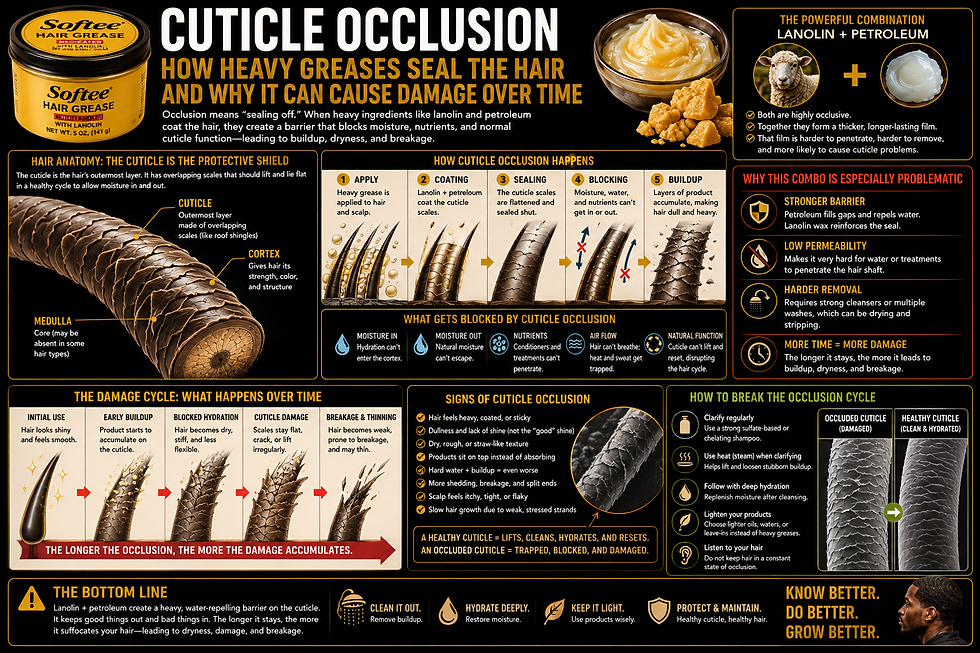
That may not sound as dramatic.
But it's much more accurate.
Could Grease Actually Protect Hair?
Yes and that's another reason this subject isn't black and white.Lubrication can be beneficial.
Hair fibers rubbing against one another creates
friction. Reducing friction can potentially reduce mechanical wear.That's especially important with tightly curled and coiled hair because bends in the fiber and repeated manipulation can create vulnerable points.
So grease isn't automatically destroying every strand it touches.The problem arises when people assume:
If some coating is beneficial, more coating must be better.
That's not necessarily true.
And something useful on the hair shaft isn't automatically something I want repeatedly sitting on the scalp. Those are two different environments.
What About Lanolin Allergy?
This is another legitimate issue, although it shouldn't be exaggerated.
Some individuals can develop allergic contact dermatitis to lanolin or lanolin derivatives.
That may present as itching, redness, irritation or rash.
But I wouldn't say everybody—or even most people—is allergic to lanolin.They aren't.
The takeaway is simply that someone experiencing persistent irritation after using a lanolin containing product shouldn't automatically assume their scalp is merely “dry.” The product itself could potentially be part of the problem.
And That “Dry Scalp” Question Matters
This is one of the cultural habits I think deserves reconsideration.
Scalp itching?
Add grease.
Flakes?
Add grease.
Scalp feels tight?
Add grease.
Hair looks dull?
Add grease.
But those symptoms don't necessarily have the same cause. Flaking could involve dandruff or seborrheic dermatitis.
Itching could involve irritation.
Bumps could involve folliculitis or acne.
Scaling could represent an inflammatory condition.
And unexplained hair loss could have multiple causes.
Covering every scalp symptom with grease can make the scalp look temporarily lubricated without identifying why the symptom exists.
That's why my philosophy has changed.
I Prefer a Simple Scalp Routine
For routine care, my preference is straightforward:
Cleanse the scalp appropriately and put most conditioning, lubricating and styling products where they're actually needed—on the hair.
That doesn't mean nobody should ever put anything on the scalp besides shampoo.
That statement would be too absolute.
There are legitimate scalp treatments for dandruff, seborrheic dermatitis, psoriasis, infections and other conditions.
But those products have a purpose.
That's different from automatically coating a healthy scalp in grease because that's what generations before us were taught to do.
Lanolin Does NOT Equal Hair Growth
This deserves its own section because hair-care marketing has blurred this distinction for decades.
A product can make hair:
softer, shinier, easier to comb and less prone to friction-related breakage.
If less hair breaks, you may retain more length.
If you retain more length, it can look like your hair is “growing better.”
But:
LENGTH RETENTION ≠ FASTER FOLLICULAR GROWTH.
I haven't found compelling evidence demonstrating that putting lanolin on the scalp makes human follicles produce hair faster.
Lanolin's established cosmetic value is primarily associated with its emollient and protective/occlusive characteristics. (PubChem)
That's very different from a clinically demonstrated hair-growth drug.
So Why Did Our Hair Seem to Grow So Well When We Used Grease?
Because hair growth and visible length aren't the same measurement. Imagine your scalp produces six inches of hair during a certain period.
If three inches break off, you retain three.
If lubrication and gentler styling reduce breakage so that only one inch breaks, you retain five.
The follicle didn't necessarily grow faster.
You kept more of what you grew.
That distinction can explain some of the legendary stories surrounding traditional products without dismissing people's real experiences.
Grandma may absolutely have seen longer hair while using grease.
The scientific question is why.
I Don't Want to Demonize Our Grandmothers
This conversation isn't about mocking previous generations.
They worked with the information and products available to them.
And Black hair care developed under uniqueeconomic, cultural and social circumstances.People created routines that made tightly textured hair manageable with the technology available at the time.
Grease provided immediate results.
It was inexpensive.
Accessible.
Long-lasting.
Easy to understand.
And effective for styling.
Our grandparents weren't reading modern cosmetic chemistry literature before doing somebody's hair on Saturday night.
They were doing what worked.
Now we have an opportunity to ask more questions.
That's progress not disrespect.
And I'm Not Calling Lanolin “Poison”
Lanolin is not poison.
It's a cosmetic and pharmaceutical ingredient with established legitimate uses. PubChem describes it as an emollient and cosmetic/pharmaceutical aid, and Cosmetic Ingredient Review assessments referenced through PubChem have found lanolin wax safe under current cosmetic conditions of use. (PubChem)
That's why my argument isn't:
NATURAL = GOOD
or
PETROLEUM = BAD
or
SHEEP = BAD.
My concern is much more specific:
Do we need to routinely put heavy occlusive hair dressings directly on a healthy scalp?
My answer is no.
The Question Black Hair Science Still Needs to Answer
This is where I want this conversation to go.
We already have historical evidence connecting prolonged pomade exposure with acneiform eruptions.
We have a remarkable 1970 study involving hundreds of Black men showing an association between long-term pomade use and characteristic comedonal eruptions. (JAMA Network)
We know some traditional thick hair dressings contained combinations of petrolatum, lanolin and oils. (PubMed Central (PMC))
And we know androgenetic alopecia involves follicular miniaturization. (PubMed)
What I want is research examining the intersection.
What happens when genetically susceptible follicles coexist with years of:
heavy scalp product use, repeated brushing, compression, friction, inflammation, follicular plugging and different cleansing habits?
Does it make no meaningful difference?
Does it aggravate certain scalp conditions?
Does it accelerate breakage that gets mistaken for follicular loss?
Does inflammation matter in a subgroup?
Are wave routines completely unrelated to later thinning?
We shouldn't pretend we know the answers before doing the research.
But we should absolutely be asking the questions.
My Position Today
After examining these ingredients and the historical evidence surrounding pomade use, I don't recommend routine application of heavy lanolin/petrolatum grease directly to the scalp.
That is my position.
It's stronger than simply saying “everything in moderation.”
At the same time, I'm not going to tell you that science has proven Softee caused male pattern baldness when it hasn't.
Those two positions aren't contradictory.
I can reject a grooming practice without inventing evidence against it.
I can believe that years of heavy scalp greasing deserve investigation while acknowledging that androgenetic alopecia is a real, well established form of hair loss.
And I can question what happened during decades of Black grooming culture without blaming Black people for their own hair loss.
The Bottom Line
Softee Hair Food gives us a fascinating window into traditional Black hair care. Its formulas have prominently featured ingredients such as petrolatum and lanolin, with some ingredient declarations also listing mineral oil and paraffin. Softee's own directions have included applying the product directly to the hair and scalp as a special treatment. (Instacart)
Lanolin itself is a refined wool wax produced from material secreted by sheep sebaceous glands. It has legitimate emollient and protective properties. (PubChem)
But the historical evidence around pomades shouldn't be ignored either.
Researchers documented pomade acne in Black men decades ago, and dermatological literature recognizes thick emollient hair products containing combinations of petrolatum, lanolin and oils as potential contributors to comedonal eruptions. (JAMA Network)
Does that prove lanolin caused generations of Black men to go bald?
No.
Do I believe we should investigate the long-term relationship between intensive wave routines, heavy pomades, brushing, compression, scalp inflammation and hair loss in Black men?
Absolutely.
And until those questions are answered, my approach remains simple:
Clean the scalp. Condition the hair. Treat actual scalp conditions appropriately. Don't assume grease equals moisture. Don't assume shine equals health. And don't assume a tradition should continue simply because we've practiced it for generations.
We can honor Black hair history while still questioning it.
In fact, that's exactly why we should question it.


I came across this because I am looking to highlight products made with lanolin. I raise sheep and with children, I also raise hair. I was going down the "Grandmother" path and bought Tub O Butter, Le Kair conditioner and Sulfur 8. All have lanolin. But when I went to add these to the hair an inner voice said "suffication". I believe it is petroleum. It is like a carrier to lanolin, which is not a thick substance once skimmed off. It's oily with a multitude of benefits if used in its natural form. yes. And I agree, use these products sparingly, not generously as directed and wash it out as you would your own skin when you shower and…