
The Psychology of Protective Styling: When Did Braids Become the Default for Black Women, and What Did We Lose Along the Way?
Black women, when did protective styling become something we felt we HAD to do instead of something we WANTED to do? And did some of us inherit hair routines without ever being taught how to actually care for our natural hair?
The Psychology of Protective Styling: When Did Braids Become the Default for Black Women, and What Did We Lose Along the Way?
By Cyn Doll | Hair Loss, Hair History, Self-Image & Healing
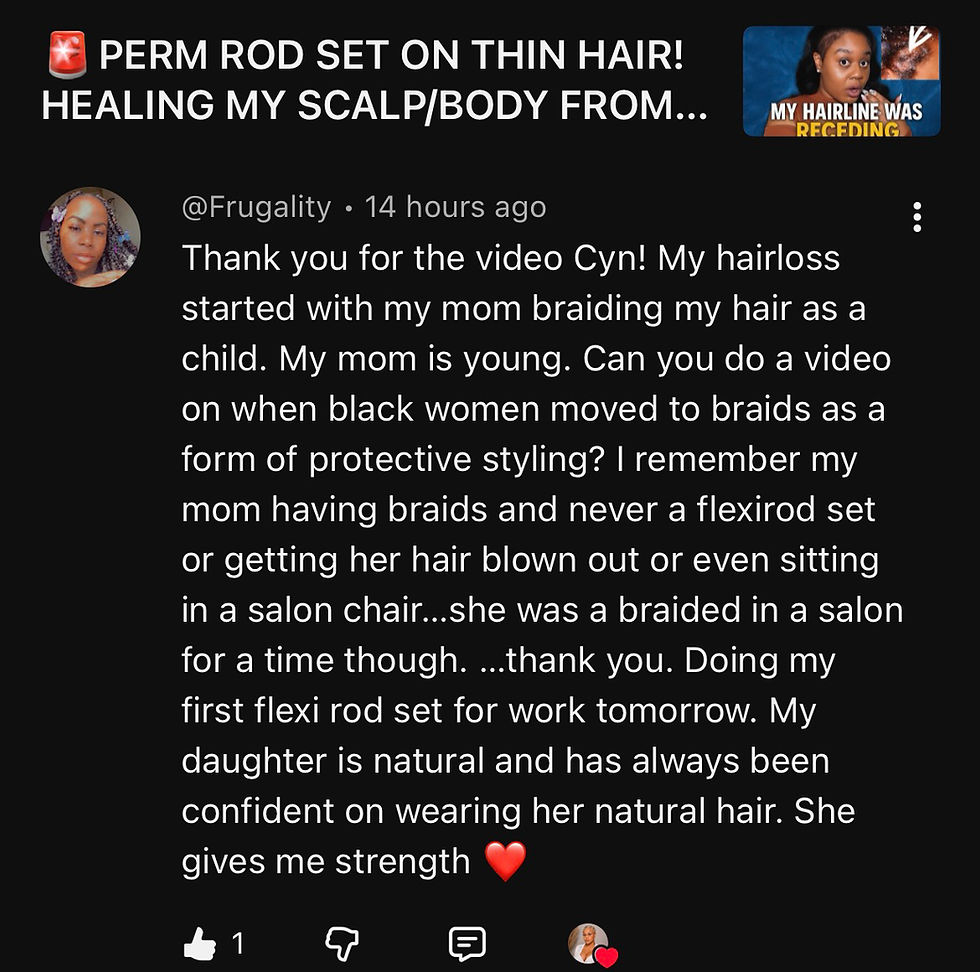
Baby, this comment touched on something much deeper than braids, flexi rods, or natural hair.
This woman is describing three generations of Black women with three different relationships to their hair.
A mother who primarily knew braiding. A daughter who experienced hair loss beginning in childhood. And a granddaughter who confidently wears her natural hair without the same fears.
That’s not just a conversation about hairstyles. That’s a conversation about generational conditioning, beauty standards, bodily autonomy, and how the things we learn as children can follow us into adulthood.
And I want to explore something that we don’t discuss enough in the Black hair community:
When did protecting our hair become so closely connected to keeping it hidden, controlled, or untouched?
Because there’s a difference between protecting your hair from damage and developing a fear of wearing your hair freely.
And sometimes, without realizing it, we pass that fear down.
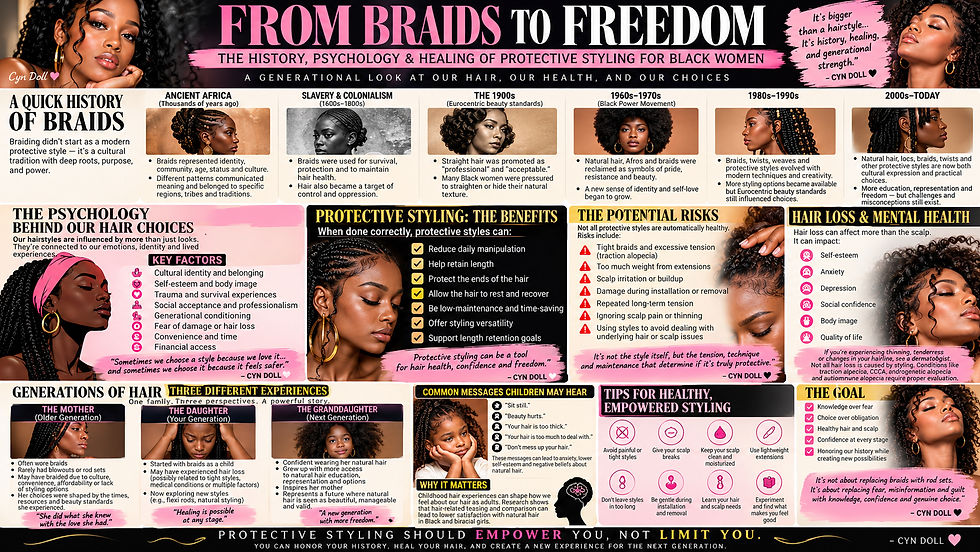
1. Black women did not suddenly move to braids. Braiding was already part of our history.
First, we need to correct something about the history.
Braiding did not begin as a modern protective hairstyle. Its roots go back thousands of years across African societies.
According to the Smithsonian National Museum of African American History and Culture, hairstyles such as cornrows and Bantu knots have been passed down across generations, serving cultural, social, and practical purposes.
Braids could communicate identity, community, age, status, and belonging. They were not simply about retaining length or avoiding breakage.
But here’s where the conversation becomes interesting.
Over time, particularly through slavery, colonialism, segregation, and Eurocentric beauty standards, Black women’s relationships with their hair changed.
Hair was no longer just cultural expression. It became something that could influence how a woman was treated, whether she was considered attractive, and even whether she was perceived as professional.
During the 1960s and 1970s, the Black Power movement helped reclaim Afros, braids, and other natural hairstyles as symbols of cultural pride. Later generations continued reinventing these traditions through extensions, cornrows, twists, locs, and other styles.
So the answer isn’t that Black women suddenly started braiding their hair.
The bigger question is when braiding became, for some families, the primary way they knew how to manage natural hair.
That transition doesn’t have one historical date. It reflects overlapping cultural traditions, convenience, changing fashions, economics, and beauty expectations.
2. The psychology of a mother who only knew braids
Let’s talk about the mother in this comment.
The daughter remembers her mother always wearing braids, rarely getting blowouts, never experimenting with rod sets, and not spending much time in a salon chair as a client.
That tells us something about her styling experience, but it doesn’t automatically tell us why she made those choices.
Maybe braiding was convenient. Maybe it was affordable. Maybe it was a cultural tradition she loved. Maybe it was simply the hairstyle she felt most beautiful wearing.
But we also need to examine another possibility.
What happens when a woman learns how to maintain her hair but never develops confidence in styling it outside of one familiar method?
Psychologically, familiarity creates comfort. When we repeat a behavior for years, it can become our default response because it feels predictable.
For some women, braids may offer more than convenience. They may provide relief from daily manipulation, styling decisions, social judgment, and anxiety about their appearance.
That doesn’t make braiding unhealthy.
However, when a hairstyle becomes the only style someone feels safe wearing, it is worth asking whether the decision is coming from preference or fear.
And that’s where I want Black women to start being curious about their own experiences.
Are we choosing our hairstyles because we genuinely enjoy them?
Or have some of us learned to believe our natural hair is too difficult to handle any other way?
Those are two very different relationships with hair.
3. When childhood hair routines become adult experiences
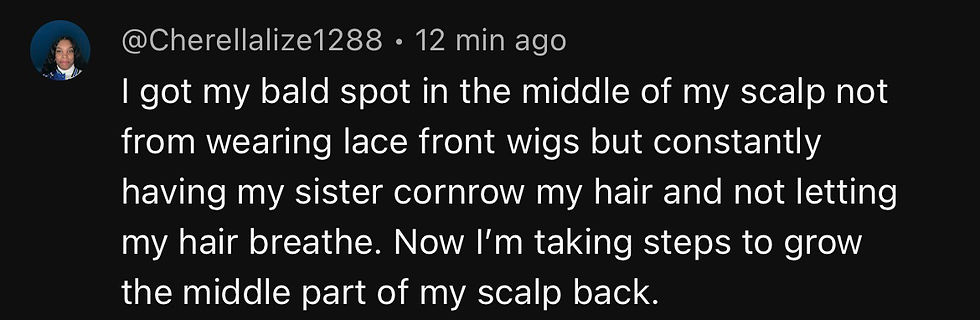
Now, the part of this comment that really caught my attention was the daughter connecting her childhood braiding experiences to her hair loss.
We need to discuss this carefully because there is a legitimate medical concern here.
The American Academy of Dermatology confirms that repeatedly tight braids, cornrows, extensions, and other tension-producing hairstyles can cause traction alopecia.
And yes, children can develop traction alopecia. Prolonged tension can eventually cause permanent follicle damage.
But not every woman who wore braids as a child will experience hair loss. And we cannot diagnose this woman’s particular hair loss from her comment.
What interests me psychologically is what happens when a child experiences discomfort or damage during a routine that adults describe as care.
Think about the messages some little girls may hear:
“Sit still.”
“Beauty hurts.”
“Your hair is too thick.”
“Your hair is too much to deal with.”
“Don’t mess up your hair.”
A child may begin to associate hair care with pain, inconvenience, restriction, or criticism.
Not every child will internalize these messages the same way. But repeated childhood experiences can influence how we feel about our appearance and our bodies.
Research involving 105 Black and biracial girls ages 10–15 found that hair-related teasing and comparison were associated with lower satisfaction with their natural hair. Positive peer support was associated with greater satisfaction.
This is why I believe hair education needs to include more than products and styling techniques.
We need to consider what we’re teaching children to believe about the hair growing out of their heads.
Because a child can grow up knowing how to sit through a hairstyle without ever learning how to love, understand, or care for her own hair.
4. Protective styling versus protective behavior
This is probably the most important distinction I want my audience to understand.
A hairstyle is not automatically protective because somebody calls it a protective style.
Protection depends on what is happening to the hair and scalp.
You can have braids that reduce daily manipulation and help preserve your ends.
You can also have braids that place excessive tension on your follicles, irritate your scalp, and contribute to hair loss.
The difference is in the installation, tension, weight, maintenance, removal, and condition of the person’s hair and scalp.
The American Academy of Dermatology specifically recommends avoiding painful, tight hairstyles and changing practices that repeatedly pull on the hair.
And this is where my philosophy comes in.
You cannot call something protective if the process of maintaining it is consistently damaging the very thing you’re trying to protect.
But this applies to more than braids.
Excessive heat, rough detangling, tight ponytails, aggressive brushing, and even improperly used rollers can create problems.
A flexi rod set is not automatically healthier than braids. A blowout is not automatically damaging. Wearing your hair loose is not automatically the best choice for everybody.
Hair care should be based on the condition of the hair, the health of the scalp, and how a style is performed.
Not on the label attached to the hairstyle.
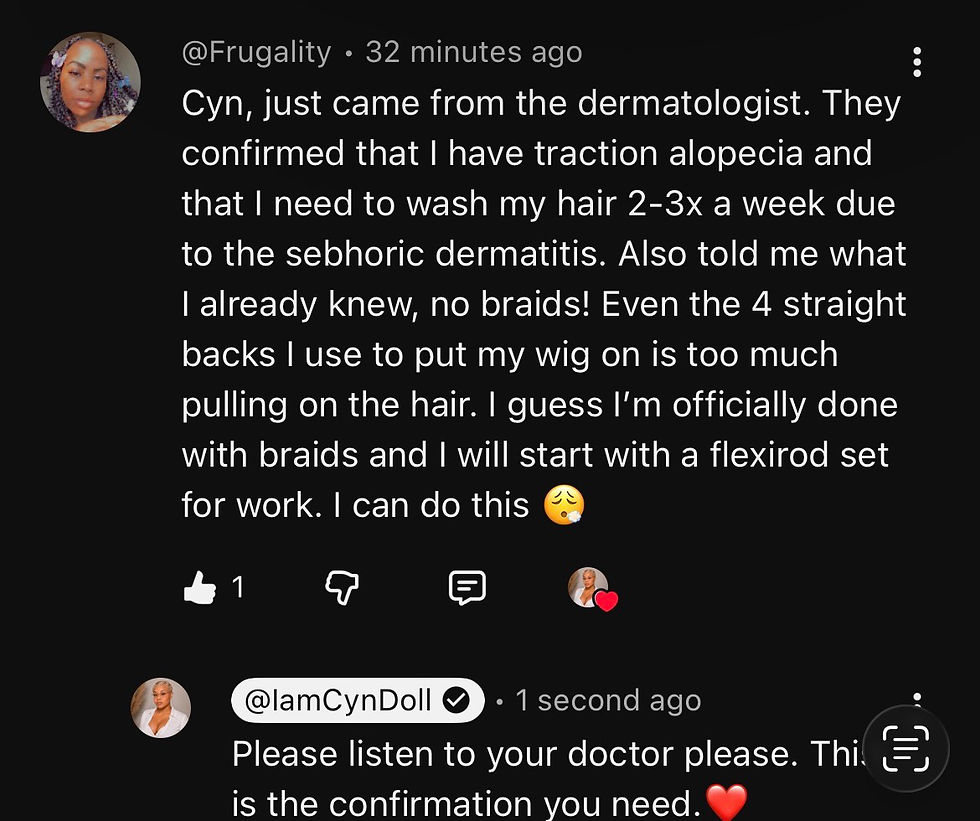
5. The granddaughter represents something powerful: the possibility of a different relationship with natural hair
The most beautiful part of this woman’s comment was when she said her daughter has always been confident wearing her natural hair.
And that her daughter gives her strength.
I want us to think about that.
Here is a grown woman learning courage from a younger woman who apparently doesn’t carry the same level of hesitation around her natural texture.
Psychologically, that is significant.
Children learn from their environments, but adults can also learn new behaviors and beliefs from their children.
Sometimes, seeing somebody else comfortably do something we’ve avoided helps us question our own assumptions.
Maybe the mother grew up believing hair needed to be braided to remain manageable.
Maybe the daughter experienced hair loss and developed concerns about styling.
And now the granddaughter is demonstrating another possibility: that natural hair can be worn openly, confidently, and creatively.
We don’t know every detail of this family’s experience, so we shouldn’t assume their beliefs or assign blame.
But the contrast raises an important question.
What if the next generation doesn’t need to inherit every fear, restriction, or beauty rule that the previous generation learned?
What if a young Black girl grows up knowing that her coils aren’t a problem to solve?
That her hair doesn’t have to be stretched to be beautiful?
That braids are an option rather than an obligation?
And that she can enjoy a silk press, an Afro, a twist-out, a rod set, or cornrows without attaching her self-worth to any one of them?
That’s the kind of freedom I want us to discuss.
6. Hair loss can affect more than the scalp
There’s another psychological layer we cannot ignore.
When someone begins losing hair, especially after years of associating hair with femininity, beauty, and identity, the experience can affect their emotional well-being.
The American Academy of Dermatology acknowledges that hair loss can be associated with anxiety, depression, and reduced self-esteem, and emphasizes the importance of proper diagnosis and support.
And this is why I don’t believe the solution is always another hairstyle.
Sometimes a woman needs a dermatologist.
Sometimes she needs education about her scalp.
Sometimes she needs to learn a different styling technique.
And sometimes she needs to rebuild confidence after years of being uncomfortable with how her hair looks.
These needs can exist together.
We should also stop assuming that all Black women’s hair loss is caused by styling.
Conditions such as central centrifugal cicatricial alopecia, androgenetic alopecia, and autoimmune alopecia require proper evaluation.
Healing your relationship with your hair and treating a medical scalp condition are two different processes, and both deserve attention.
7. What I would say to the woman who left this comment
Baby, first, thank you for trusting me with part of your story.
What stood out to me wasn’t just that your mother braided your hair. It was that you’re now trying something different, even after experiencing hair loss and growing up with a very specific approach to hair care.
And I want you to give yourself credit for that.
Your mother may have been doing what she knew, what was practical, or what had been passed down to her. We don’t have to villainize our mothers to examine the effects of the routines we inherited.
We can appreciate their intentions while acknowledging that some methods may not have been appropriate for every child’s scalp.
And I love that your daughter inspires you.
Because confidence can be learned at any age.
You don’t have to know every technique. You don’t have to have the thickest hair. You don’t have to recreate somebody else’s hair journey.
You can learn your hair as it exists today.
And if you’re experiencing ongoing thinning, tenderness, or changes in your hairline, please consider seeing a dermatologist rather than assuming it’s only from childhood braiding.
As for that first flexi rod set you’re doing for work tomorrow, I hope you enjoy the experience.
Not because a rod set makes you more beautiful than braids.
But because you deserve to experience your hair as something you can explore, rather than something you have to fear.
8. My final thought: Are we protecting our hair or protecting ourselves from judgment?
I think this is the conversation that could change how we approach Black hair care.
For generations, Black women have navigated beauty standards that questioned the professionalism, femininity, and acceptability of our natural hair.
And some of those pressures still exist today.
The Smithsonian documents how hair discrimination and Eurocentric beauty standards have influenced Black people’s styling choices, including decisions to straighten or conceal natural textures.
So when we discuss protective styling, we need to acknowledge both realities.
Braids are a beautiful part of Black cultural history.
And some styling practices can become physically damaging or psychologically restrictive when they are accompanied by excessive tension, fear, or shame.
Both things can be true.
I am not interested in telling Black women to stop braiding their hair.
I am interested in helping us recognize when our routines are serving us and when we are serving our routines.
Because protecting your hair should never require you to ignore your scalp.
And embracing your natural hair should never require you to abandon the cultural styles you love.
The goal isn’t to replace braids with flexi rods. The goal is to replace fear and misinformation with knowledge, confidence, and genuine choice.
And maybe that’s what this woman and her daughter are showing us.
Sometimes generational change doesn’t look like a big announcement.
Sometimes it looks like a mother trying her first flexi rod set before work, encouraged by a daughter who has never been afraid to wear her natural hair.
And that, baby, is a conversation worth having.
— Cyn Doll ❤️
Research behind this article
The historical and medical claims are supported by the Smithsonian National Museum of African American History and Culture, the American Academy of Dermatology, and peer-reviewed research on Black girls’ hair experiences. The psychological interpretations are discussion points, not diagnoses of the commenter or her family.


Comments