
The Root Cause of Scalp Issues
I want to start with something that a lot of people didn’t want to hear when I first said it…

Your hair routine might actually be damaging your scalp.
Not immediately.Not overnight.
But slowly… over time.
And when I first started talking about this, people pushed back hard.
They said:
“This works for me.”
“Everyone oils their scalp.”
“My hair is growing fine.”
And I understood that.
Because in the beginning… it does look like it’s working.

Hair can still grow for a while even when the scalp environment is starting to become unbalanced.
The follicles are still functioning.The scalp is still compensating.
But what most people don’t realize is:
Hair damage is delayed.
Scalp damage builds quietly and shows up later.
From a biological perspective, this is what we call cumulative stress on the follicle environment.
Inflammation, buildup, and imbalance don’t always show up immediately.
They build over time — and then suddenly, you see:
thinning
shedding
sensitivity
breakage at the root
And now….
I’m seeing more and more people dealing with:
thinning at the crown
sensitive or irritated scalp
buildup that won’t go away
hair that suddenly stopped growing
And the question is always the same:
“Why is this happening now?”
Because the routine didn’t change.
The products didn’t change.
So what did?
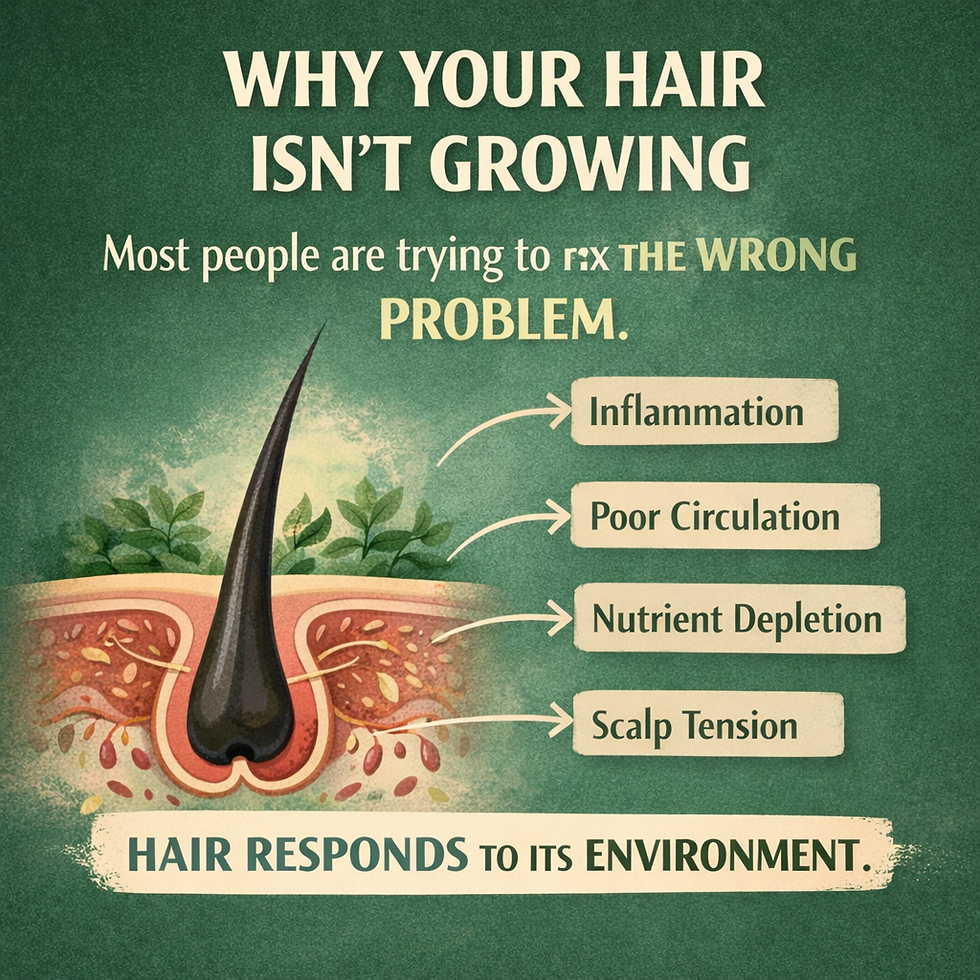
The scalp environment changed.
This happens in real life more than people realize.
Someone can follow the same routine for 3–5 years…
Oiling their scalp weekly,Using heavy butters,Keeping styles in for long periods.
And everything seems fine…
Until one day:
their edges start thinning
their scalp feels sore
the hair doesn’t grow the same
It's not random.
That’s the environment catching up!
Here’s the shift you need to understand:
Hair does not control hair growth,The scalp does.
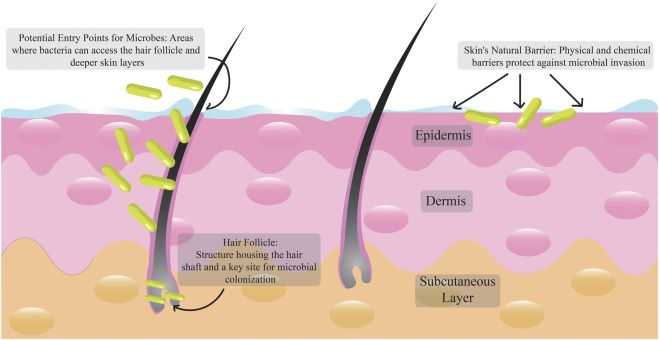
Your scalp is not just skin.
It’s a biological system!

It includes:
a protective barrier
a microbiome (bacteria + fungi)
blood flow feeding the follicles
immune responses

From a science standpoint, your scalp functions like any other skin organ in the body.
It has a stratum corneum barrier, which regulates moisture and protects against irritation.


It has a microbiome, which must stay balanced to prevent overgrowth of certain organisms.

And it has a vascular supply, meaning your follicles rely on proper circulation to grow healthy hair.

Hair follicles
Are living structures that depend on that environment.
So when that environment is off…
Hair growth will always struggle.
There are 3 major disruptions I see over and over again:
1. Inflammation
This is one of the biggest hidden causes of:
itching
thinning
sensitivity
Inflammation can come from:
product irritation
buildup
tight styles
microbiome imbalance
When inflammation stays on the scalp long-term…
It starts affecting the follicle.
From research, we know that inflammatory signals can actually disrupt the hair growth cycle.
And over time:
growth slows
strands become thinner
follicles weaken
some follicles stop producing hair
Real life example:
Someone constantly scratching their scalp, feeling irritation, or tenderness — but ignoring it — is often dealing with low-grade inflammation.

2. Microbiome Imbalance
Your scalp has an ecosystem.
And when that balance is off…
That’s when you see:
dandruff
irritation
flakes
One of the most common organisms is Malassezia.
And here’s what most people don’t know:it feeds on oils
Scientifically,
Malassezia breaks down lipids and releases byproducts that can irritate the scalp.
So when people are constantly applying:
oils
grease
heavy products

They can unintentionally fuel the imbalance.
Real life example:
Someone who oils their scalp daily and starts noticing flakes or itching — but thinks they need more oil — is actually making the environment worse.

3. Follicle Blockage (Occlusion)
The scalp is not meant to be constantly coated.
But many routines involve:
layering products
not fully cleansing
reapplying oils repeatedly
This creates:
buildup
blocked follicles
reduced airflow
From a dermatology perspective, this is called occlusion.
Occlusion can:
trap sweat
trap bacteria
block normal skin function
And over time…
That affects growth.
Real life example:
Someone wearing wigs or extensions with product buildup underneath for weeks — then experiencing itching or bumps is dealing with an occlusive scalp environment.

Now let’s go deeper because this is where most people have never been taught.
Oils, Grease, and Layering
When oils sit on the scalp:
they trap heat
they trap moisture
they reduce oxygen

And they create a lipid-rich environment
And research shows:
certain organisms thrive in that environment
This doesn’t mean oils are automatically bad.
But it does mean:
constant exposure without proper balance creates problems.
Real life pattern:
oil → buildup → irritation → more oil → more imbalance
Wet Scalp
Another big issue:
Keeping the scalp wet too long.
This can:
weaken the scalp barrier
increase microbial activity
create instability
From a science standpoint, overhydrated skin becomes more vulnerable to irritation and imbalance.
Especially when combined with:
oils
buildup
covered styles
Real life example:
Going to sleep with a damp scalp repeatedly or keeping styles in while the scalp stays moist can lead to:
odor
itching
imbalance
Now this is important…
Because many people think they have “dry scalp.”

But it’s often one of these:
1. Fungal Overgrowth
Flakes, itching — feeds on oils
2. Seborrheic Dermatitis
Redness, greasy flakes
3. Folliculitis
Bumps, tenderness
4. Traction Damage
Tension + inflammation

5. Psoriasis
Thick scaling, immune response
6. Contact Dermatitis
Reaction to products

So now I want to ask you something…
Instead of asking:“What product should I use?”
Ask yourself:
“What environment am I creating on my scalp?”
Because that one question changes everything.
When I first started saying this…
People didn’t like it.
Because it challenged what they believed.
But now…
We’re seeing the results.
People who followed those routines long-term are now dealing with the exact issues I was talking about.
And this is exactly why I created my training.
Because once you understand:
what’s happening on your scalp
what condition you actually have
what’s causing the imbalance
Everything becomes clear.
Now here’s where most people make the mistake…
They hear information like this…
And immediately think:
“Okay… so what product do I need to fix this?”
But from a biological standpoint…
That question is already part of the problem.
Because what we’re talking about is not just a surface-level issue.
This is a system-level issue.
Your scalp is part of the integumentary system — the same system studied in dermatology.
And that system is regulated by:
• barrier function (stratum corneum)
• microbial balance (microbiome)
• immune signaling (inflammation pathways)
• vascular supply (blood flow to follicles)
And research consistently shows this:
When the skin barrier is disrupted…
It increases:
• transepidermal water loss
• sensitivity
• microbial imbalance
• inflammatory signaling
Studies published in dermatology literature
(like The Journal of Investigative Dermatology) show that:
👉 barrier disruption and inflammation are directly linked to hair follicle dysfunction
So what does that mean in real life?
It means when you constantly:
• overload oils
• create buildup
• keep the scalp occluded
• maintain prolonged moisture
You are not just “doing a routine.”
You are altering the biological environment of your scalp.
And over time…
That environment begins to influence the follicle.
Let me break that down further.
Hair follicles operate in cycles:
• anagen (growth phase)
• catagen (transition)
• telogen (resting/shedding)
Research shows that inflammation can:
• shorten the anagen phase
• increase shedding
• weaken follicle output
And this is where we see something important:
follicle miniaturization

This is when the follicle begins producing:
• thinner hair
• weaker strands
• slower regrowth
This process is documented in both androgenic and inflammatory hair loss studies.
And here’s the part most people miss:
By the time you SEE thinning…
The biological process has already been happening.
Real-life example:
Someone says:
“My hair used to be thicker.”
But what actually happened was:
• months (or years) of low-grade inflammation
• repeated buildup
• microbiome imbalance
And now the follicle has adapted to that environment.
This is why quick fixes fail over and over.
Because you’re trying to reverse a long-term biological process with:
a short-term product solution
And this is why people feel stuck.
They’re doing more…
But not understanding more.
So let me say this clearly:
You do not fix hair growth by adding more.
You fix it by correcting the scalp environment.
And once that environment begins to stabilize…
That’s when you start to see:
• reduced inflammation
• improved scalp comfort
• decreased shedding
• stronger, more consistent growth
But here’s where it gets important…
Not everyone has the same scalp condition.
Not everyone has the same imbalance.
And not everyone needs the same approach.
And this is exactly why I created my courses.
Because I realized something:
People don’t need more products.
They need:
✔ understanding
✔ structure
✔ a way to identify what’s actually happening
So inside my training and courses…
I don’t just tell you what to use.
I teach you how to:
• identify your specific scalp condition
• understand your scalp biology
• recognize signs of inflammation and imbalance
• correct the environment step-by-step
• support long-term follicle health
Because once you understand that…
Everything changes.
You stop:
• guessing
• product hopping
• following random routines
And you start:
• making informed decisions
• supporting your scalp correctly
• seeing consistent results
So if you’ve been sitting here thinking:
“Wait… this actually sounds like what I’ve been dealing with…”
That’s not random.
It means your scalp has been signaling imbalance.
And now…
You’re finally understanding what those signals mean.
Hair growth is not random.
It’s not just genetics.
It’s not just products.
It is a biological process.
And once you understand the system behind it…
You stop chasing products…
And you start supporting the system.
If you want to go deeper into this…
And actually learn how to apply this to your own scalp…
You can join my full course where I break everything down in detail.
And if this resonated with you…
Type “SCALP”
So I can help you start identifying what’s going on.


Comments