
WHAT I BELIEVE GREASE IS ACTUALLY DOING TO THE HAIR & SCALP
Updated: Aug 27
WHAT I BELIEVE GREASE IS ACTUALLY DOING TO THE HAIR AND SCALP
Occlusion, Sebum, the Scalp Microbiome and Why “Soft” Does Not Automatically Mean Healthy
By Cyn Smith, aka Cyn Doll
Hollictic Research Scientist
Holistic Hair + Scalp Research
A quick introduction before we get into the science:

I started my career as a cosmetologist, but I didn’t stop at learning how to do hair. I wanted to understand the biology and science behind what I was seeing, so I took my education further—and I’m continuing to take it much further.
I approach hair and scalp health as a scientist and researcher. I observe patterns, develop hypotheses, study biological mechanisms, compare those observations with published research, and remain willing to change my conclusions when better evidence becomes available.
I’m not here to argue. I’m here to investigate.
Debate for the sake of debate gets us nowhere. If you disagree with something I present, that’s perfectly fine. Bring research. Bring data. Bring a biological mechanism worth investigating. That’s how science moves forward.
But personal attachment to a product, tradition, technique, or belief is not scientific evidence.
Science should not be emotional. A result doesn’t become true because we like it, and it doesn’t become false because it challenges something we’ve done for years.
My work will sometimes challenge conventional cosmetology teachings including things I was originally taught myself. That is the point of continuing your education.
I’m not asking anyone to blindly believe me. Read the research. Examine the evidence. Observe your own results. Ask better questions.
Take the information or leave it. But if we’re going to discuss the science, let’s discuss the science.
Take the emotion out of or sign out.
After years of observing hair and scalp behavior, I have developed a working thesis that is different from the way grease and oil are usually discussed in hair care.
My position is not simply:
“Petroleum is bad.”
That is too simplistic.

Holistic Hair + Scalp Research
“My hair was so soft.”
That may describe a successful styling result. It does not, by itself, prove that the hair became healthier—or that the scalp tolerated the routine well.
A comment recently caught my attention:
“I followed your method of leave-in and grease before blow drying and was shook. My hair was so soft!!”

I believe the commenter. Leave-in conditioner, petrolatum-based grease, blow-drying and flat-ironing can make hair feel remarkably smooth by reducing friction, coating the fiber and temporarily improving its surface alignment.
But immediate softness is a cosmetic observation, not evidence of structural repair or scalp health.
That distinction is the central thesis of this article:

Hair can feel softer because its surface has been lubricated while underlying fiber damage remains unchanged and while the scalp beneath it may be irritated, inflamed or accumulating product.
Petrolatum is not inherently harmful, and it is a well-established occlusive that can be useful in appropriate dermatologic contexts. However, the evidence remains unresolved regarding whether repeated scalp use directly alters the microbiome, increases Malassezia activity, contributes to follicular plugging or causes inflammation in a particular person. The more precise question is what may happen when a heavy occlusive is repeatedly applied to a living, sebum-producing scalp and combined with heat, sweat, styling residue, mechanical manipulation and delayed cleansing—especially in someone already experiencing dandruff, seborrheic dermatitis, folliculitis, buildup, itching or barrier irritation.
To evaluate that question responsibly, we must separate three outcomes that are often treated as interchangeable:
how the hair feels,
what has happened to the hair fiber,
and what is happening on the scalp.
These outcomes are related, but they are not the same. Hair may feel soft because it has been coated, while the strand still carries thermal or mechanical damage and the scalp remains healthy, irritated or somewhere in between.
Some aspects of this discussion are established by research. Others are biologically plausible but depend on the individual, product, amount, frequency and scalp condition. Still others remain unresolved.

My concern is what happens when we repeatedly cover a naturally functioning scalp and hair fiber with external grease and oils, particularly when the scalp is already producing its own sebum, harboring its own microbial community and constantly exchanging water with its surroundings.
What I repeatedly observe is that when people stop constantly applying oils and grease directly to the scalp and hair, cleanse appropriately and allow the scalp’s own biology to function, many of them begin producing enough natural sebum to coat the scalp and gradually travel onto the hair.
Hair that they previously described as “dry” begins looking shinier, more flexible and better lubricated without requiring repeated layers of grease.
That clinical observation is important to me.
But it needs to be separated from what science has already proven.
So here is my thesis.
THE SCALP IS ALREADY A LIPID-RICH ECOSYSTEM
A healthy scalp is not a blank surface waiting for us to put oil on it.
It already produces oil.

Sebaceous glands associated with the hair follicle continuously produce sebum.
That sebum is released through the pilosebaceous unit and reaches the skin surface.
Sebum contains triglycerides, wax esters, squalene, cholesterol-related lipids and fatty acids.
Those lipids serve several biological and physical purposes.
They contribute to lubrication.
They participate in the skin surface environment.
They interact with the scalp microbiome.
And they naturally coat portions of the hair emerging from the follicle.
The scalp is also populated by microorganisms including:
Malassezia,
Cutibacterium,
Staphylococcus,
Corynebacterium,
and many others.
This is normal.
The scalp is not supposed to be sterile.
Modern microbiome research shows that oily skin sites support microorganisms that are adapted to lipid-rich environments, particularly Malassezia and Cutibacterium. Sebum itself provides nutrients for several lipophilic microorganisms. (PubMed Central (PMC))

So before we put anything on the scalp, there is already an active system involving:
sebum + water + keratin + microorganisms + immune activity + environmental exposure.
That matters.
THEN WE ADD GREASE
Petrolatum and many heavy hair greases are strongly occlusive.

Occlusion means that the material forms a hydrophobic barrier that reduces water loss from the surface underneath it.
Petrolatum is so effective at doing this that researchers commonly use it as a positive control when studying skin occlusion.
Studies measuring transepidermal water loss have shown that petrolatum substantially reduces water loss from skin. (PubMed)
That property is exactly why petrolatum can be excellent in certain medical situations.
If damaged skin is losing excessive water, reducing that water loss can be beneficial.
But scalp hair care is a different biological context.
The scalp already has:
sebum,
sweat,
microorganisms,
dead skin cells,
and environmental material.
So when we repeatedly spread a thick occlusive layer over that environment, my question becomes:
What are we retaining underneath that layer?
Not because grease magically creates bacteria or fungi.
It does not.
Those microorganisms were already there.
But the physical conditions surrounding them have changed.

OCCLUSION CAN CHANGE MICROBIAL CONDITIONS
This part of my thesis is strongly supported by broader skin microbiome research.
Occluded skin becomes warmer and more humid.
Skin microbiology studies have repeatedly shown that moist and occluded anatomical regions support microbial communities different from dry exposed sites.
A major review of the skin microbiome notes that partially occluded regions have higher temperature and humidity and that these conditions encourage growth of microorganisms adapted to moist environments.

That same review reports that skin occlusion can raise skin-surface pH, which can alter which microorganisms are favored. (PubMed Central (PMC))
Another review states that complete, prolonged skin occlusion can increase humidity, pH and microbial growth. (PubMed Central (PMC))
This does not prove that putting hair grease on somebody’s scalp automatically produces disease.
But it supports the biological principle behind my concern:
Occlusion changes the environment in which microorganisms are living.
That is important.
I DO NOT BELIEVE WE SHOULD THINK OF GREASE AS “MOISTURE”
This is one of my biggest disagreements with mainstream hair language.
Grease can help retain water.
That is different from being water.
Petrolatum is an occlusive.
Its primary moisture-related function is slowing water loss.
Researchers studying moisturizers distinguish between:
humectancy — attracting or binding water,
emolliency — smoothing a surface,
and
occlusion — reducing water loss.

Those mechanisms are not interchangeable. (PubMed)
So when somebody applies grease and says:
“My hair is moisturized because it became soft,”
I think we need to ask what actually changed.
Did the hair acquire significantly more water?
Or did friction decrease because the fiber was coated?
Those are two different outcomes.
HAIR CAN BE SOFT BECAUSE IT HAS BEEN COATED
The hair shaft is keratinized tissue.
Once it emerges from the scalp, it is biologically dead.
It cannot heal itself like skin.
Hair products can dramatically improve the way damaged hair behaves.
They can:
reduce friction,
smooth lifted cuticles,
increase shine,
improve combability,
and make rough strands feel soft.
But none of those observations prove that the original structural damage disappeared.
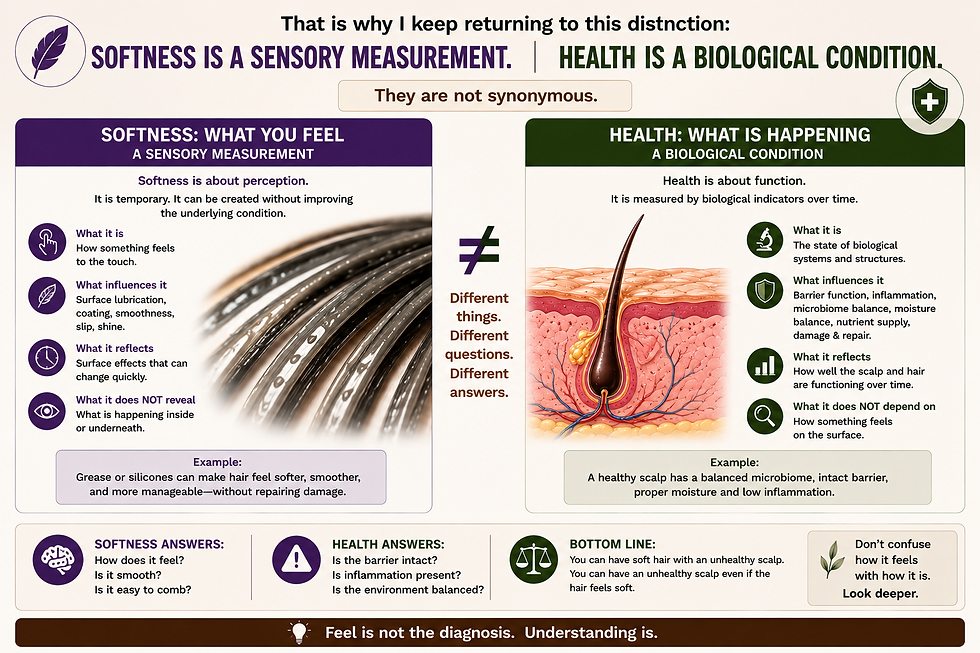
That is why I keep returning to this distinction:
SOFTNESS IS A SENSORY MEASUREMENT.
HEALTH IS A BIOLOGICAL CONDITION.
They are not synonymous.
HAIR NATURALLY EXCHANGES WATER WITH ITS ENVIRONMENT
This is another part of hair science that is often overlooked.
Hair is hygroscopic.

That means it can absorb water from its environment.
Laboratory research shows that human hair readily absorbs water and that the amount of water inside the fiber changes according to relative humidity.
One review reports that hair can increase substantially in water content and diameter as environmental humidity rises. (MDPI)
Experimental research has also shown that hair water regain rises as relative humidity increases. (PubMed)
So hair moisture is not simply:
“You drink water, therefore your hair becomes moisturized.”
Drinking adequate water is important for the health of living tissues, including the skin and follicle.
But the mature hair fiber itself exchanges water directly with its surrounding environment.
That is important for my thesis.
Because when we coat the hair with heavy hydrophobic materials, we are modifying the surface through which that normal water exchange occurs.
I would not claim that grease completely prevents all environmental water from entering the hair.
That has not been demonstrated.
But a heavy hydrophobic coating can clearly alter the fiber’s surface properties and water interaction.
And that deserves more attention.
MY WORKING THEORY IS THAT CONSTANT COATING CAN INTERFERE WITH NORMAL HAIR-WATER EXCHANGE
This is where I distinguish my clinical thesis from established research.
Hair naturally absorbs and releases water depending on environmental conditions.
Heavy grease creates a hydrophobic coating.
We therefore have a reasonable scientific question:
Does repeated heavy coating alter the normal rate at which textured hair takes up and releases environmental water?
That specific question deserves direct study.
The literature already shows that cosmetic treatments and changes to the hair fiber alter moisture sorption and desorption. (PubMed)
So I do not think it is unreasonable to investigate whether persistent grease layers also change this behavior.
What I will not say is:
“Grease blocks 100% of environmental moisture.”
We do not have evidence for that.
My position is more precise:
Grease changes the interface between the hair and its environment, and that may influence normal water exchange.
THEN THERE IS THE SCALP MICROBIOME
The scalp does not merely contain microorganisms.
Those microorganisms are metabolically active.
And some depend heavily on lipids.
Malassezia, in particular, is adapted to sebaceous areas of the body.

Recent scalp microbiome research describes Malassezia as one of the major organisms shaping the scalp microbial community and notes that scalp microbial dysregulation is associated with dandruff, seborrheic dermatitis and several inflammatory scalp diseases. (PubMed)
A newer molecular review goes even further.
It describes how Malassezia uses lipolytic enzymes to hydrolyze host sebum and generate irritating free fatty acids and oxidative products capable of participating in barrier disruption and inflammatory signaling. (PubMed)
This is an established pathway.
What has not been established is that petrolatum itself feeds Malassezia in the same manner that human sebum does.
That distinction is important.
But consider what happens underneath grease:
Your own sebum is still being produced.
The organism does not need petrolatum to create its natural lipid source.
The scalp is already supplying one.
So my concern is not necessarily:
“The petroleum is feeding the organism.”
My concern is:
We are placing an occlusive layer over a scalp where lipid-dependent microorganisms already have access to continuously produced human sebum.
That is a far stronger biological argument.
SEBUM DOES NOT STOP BECAUSE YOU GREASE YOUR SCALP
Your sebaceous glands do not detect petroleum sitting above them and shut down.
They continue secreting.
That means under a heavy layer you may have:
external grease,natural sebum,sweat,microorganisms,
shed keratin,styling-product residue,andenvironmental material.
And if that scalp is not cleansed for days because someone is preserving a hairstyle, all of those factors have more time to interact.
That is why my thesis is about accumulation and environment, not one ingredient acting alone.
THE ISSUE ISN’T THAT GREASE “CREATES” MICROFLORA
I want that distinction very clear.
The scalp’s microbial flora was already present.
The question is whether constantly coating the scalp changes the ecological conditions in which that flora lives.
Skin research tells us that microorganisms are heavily influenced by: temperature,humidity,pH,lipid availability,water availability,barrier function,
and host immunity. (PubMed Central (PMC))
Grease can influence several aspects of that surface environment through occlusion.
Sebum provides lipid substrate.
Heat can raise local temperature.
Sweating adds moisture.
Delayed cleansing leaves additional material in place.
That combination is far more interesting scientifically than simply asking whether petrolatum itself is toxic.
NOW ADD HEAT
Then people take this coated system and introduce a blow dryer.
Or a hot comb.
Or a flat iron.
Sometimes all three.
Now we have:
occlusion + sebum + microbial activity + sweat + buildup + elevated temperature + hair-fiber stress.
That is the environment I am concerned about.
We already know high heat can damage human hair.
We already know temperature and humidity affect microbial environments.
And we already know an inflamed or barrier-compromised scalp can respond differently from healthy skin.
So even if every single step seems harmless by itself, the combined routine may create a very different biological outcome.
THE PEOPLE I WORRY ABOUT MOST ARE THE ONES WHO ALREADY HAVE “DRY SCALP”
Because I frequently find that what people call dry scalp is not necessarily simple dryness.
They may actually have:dandruff,seborrheic dermatitis,
product buildup,irritant dermatitis,folliculitis,allergic contact dermatitis,or another inflammatory condition.
Then they are told:
“Your scalp is dry. Add oil.”
Or:
“Grease it.”
Then it itches again.
So they add more.
That can turn into a self-reinforcing cycle.
Itch.
↓
Assume dryness.
↓
Apply oil or grease.
↓
Reduce immediate friction or tight sensation.
↓
Delay cleansing.
↓
Sebum and product accumulate.
↓
Scalp becomes uncomfortable again.
↓
Apply more product.
This is one of the patterns I am trying to challenge.

MY CLINICAL OBSERVATION IS DIFFERENT
What I repeatedly observe is that when people stop constantly adding external grease and oil to the scalp, the scalp begins functioning differently.
They cleanse appropriately.
They stop repeatedly coating the surface.
They give the scalp time.
And their own sebum becomes more apparent.
That sebum begins coating the scalp and proximal hair naturally.
People who previously told me:
“My scalp doesn’t make oil.”
or
“My hair is naturally bone dry.”
begin showing me hair that is visibly shinier and better lubricated without constant grease application.
That observation is central to my work.
I would describe it as clinical observation, not yet as a universal physiological law.
We still need controlled research comparing:
scalp sebum distribution before and after discontinuing heavy grease,water sorption of repeatedly coated versus uncoated textured hair,
microbiome changes after chronic scalp occlusion,
scalp pH,TEWL,follicular residue,and inflammatory markers.
Those studies would tell us exactly what is happening.
BUT THERE IS ALREADY A BIOLOGICAL BASIS FOR INVESTIGATING IT
We already know:
Human sebum naturally supports lipid-dependent microorganisms. (PubMed Central (PMC))
Hair naturally takes up and releases water according to environmental humidity. (PubMed)
Petrolatum substantially decreases water loss and creates strong occlusion. (PubMed)
Occluded, warm and humid skin environments can support different microbial conditions than exposed dry sites. (PubMed Central (PMC))
Scalp microbial dysbiosis is associated with inflammatory scalp disorders. (PubMed)
Malassezia can metabolize human sebum and generate inflammatory metabolites in susceptible skin. (PubMed)
Those facts make this a legitimate biological hypothesis.
I THINK WE HAVE CONFUSED “SEALED” WITH “HEALTHY”

This may be the simplest way to explain my position.
Grease can seal.
Grease can lubricate.
Grease can shine.
Grease can make hair feel soft.
Those are real properties.
But none of them automatically means that the hair is functioning better biologically.
And on the scalp, sometimes what we are trying so hard to “seal in” is sitting beside:sweat,sebum,microbial metabolites,dead cells,
and product residue.
Occlusion is not automatically beneficial simply because reducing water loss sounds like a positive thing.
Context matters.
YOUR OWN SEBUM MATTERS
Sebum has become strangely demonized and ignored at the same time.
We shampoo it away.
Then immediately replace it with manufactured oils.
Then complain that the scalp feels dry.
Then add more oil.
I think we need to reconsider that cycle.
Your scalp has sebaceous glands for a reason.
That natural secretion participates in the surface ecosystem of the skin.
It interacts with microbes.
It helps lubricate the hair and skin.
It contributes to the acid mantle and lipid environment.
That does not mean excessive sebum is always desirable.
Too much sebum can participate in certain scalp disorders.
But the solution should not automatically be replacing the scalp’s natural lipid system with repeated heavy external coatings.
WHAT I WOULD RATHER SEE
I want to see hair care that supports normal biology.
Appropriate cleansing.
Water exposure.
Conditioning where needed.
Minimal unnecessary scalp coating.
Reduced buildup.
Controlled heat.
Healthy scalp turnover.
Recognition of inflammation when it appears.
And enough time for us to observe what the scalp actually does without constantly covering it.
Because the scalp is not passive.
It is living tissue.
THE THESIS
My working thesis is this:

Repeated heavy oil and grease application creates an occlusive surface over a scalp that already produces sebum and supports a lipid-dependent microbiome.
That occlusive environment can retain heat, humidity and accumulated material and may influence the ecological conditions surrounding the scalp microbiome.
Meanwhile, heavy coatings on the hair shaft alter its surface properties and may modify normal water exchange with the environment.
The immediate softness produced by that coating can therefore be mistaken for improved hair health.
When external oils and grease are discontinued in appropriate candidates, normal cleansing is restored and inflammation is addressed, I frequently observe natural sebum becoming sufficient to lubricate the scalp and proximal hair without constant product layering.
That is the clinical phenomenon I believe deserves formal investigation.
THE BOTTOM LINE
I am not saying:
Never use petrolatum.
I am not saying:
Every oil causes disease.
And I am not saying:
Every person should follow the exact same scalp routine.
I am saying something much more specific.
We need to stop judging a hair care method solely by whether the hair feels soft immediately afterward.
A greasy coating can make hair soft.
That does not tell us what the scalp is doing.
It does not tell us whether microbial balance improved.
It does not tell us whether inflammation decreased.
It does not tell us whether the fiber regained structural integrity.
And it does not tell us what will happen after months or years of repeating the process.
I want us to begin looking at the scalp as what it actually is:
a living, water-responsive, sebum-producing, microbially active ecosystem.
And I want us to consider the possibility that constantly covering that ecosystem may not be necessary for everyone.
Sometimes the goal should not be:
What else can I put on my scalp?
Sometimes the more important question is:
What happens when I stop interfering with it and support the biology that was already there?
That is the question guiding my work.
— Cyn Smith, aka Cyn Doll
Holistic Hair + Scalp Research
RESEARCH NOTE

The sections describing improvement after patients discontinue grease and oil reflect clinical observations and a working hypothesis. They should not be interpreted as results from a controlled clinical trial. Current evidence supports petrolatum’s occlusive properties, environmental water sorption by hair, the relationship between skin microenvironments and microbial communities, and the role of sebum-dependent microbial metabolism in inflammatory scalp disease. Direct studies are still needed to determine how chronic grease use affects the scalp microbiome, sebum distribution and hair-water exchange specifically in textured hair.


Comments