
Why Does Hair Science Make People So Angry? The Psychology Behind the Pushback in Black Hair Care
Why Does Hair Science Make People So Angry? The Psychology Behind the Pushback in Black Hair Care
I received a comment recently that genuinely made me stop and think because the question wasn’t really about shampoo, grease, oils, or even hair.
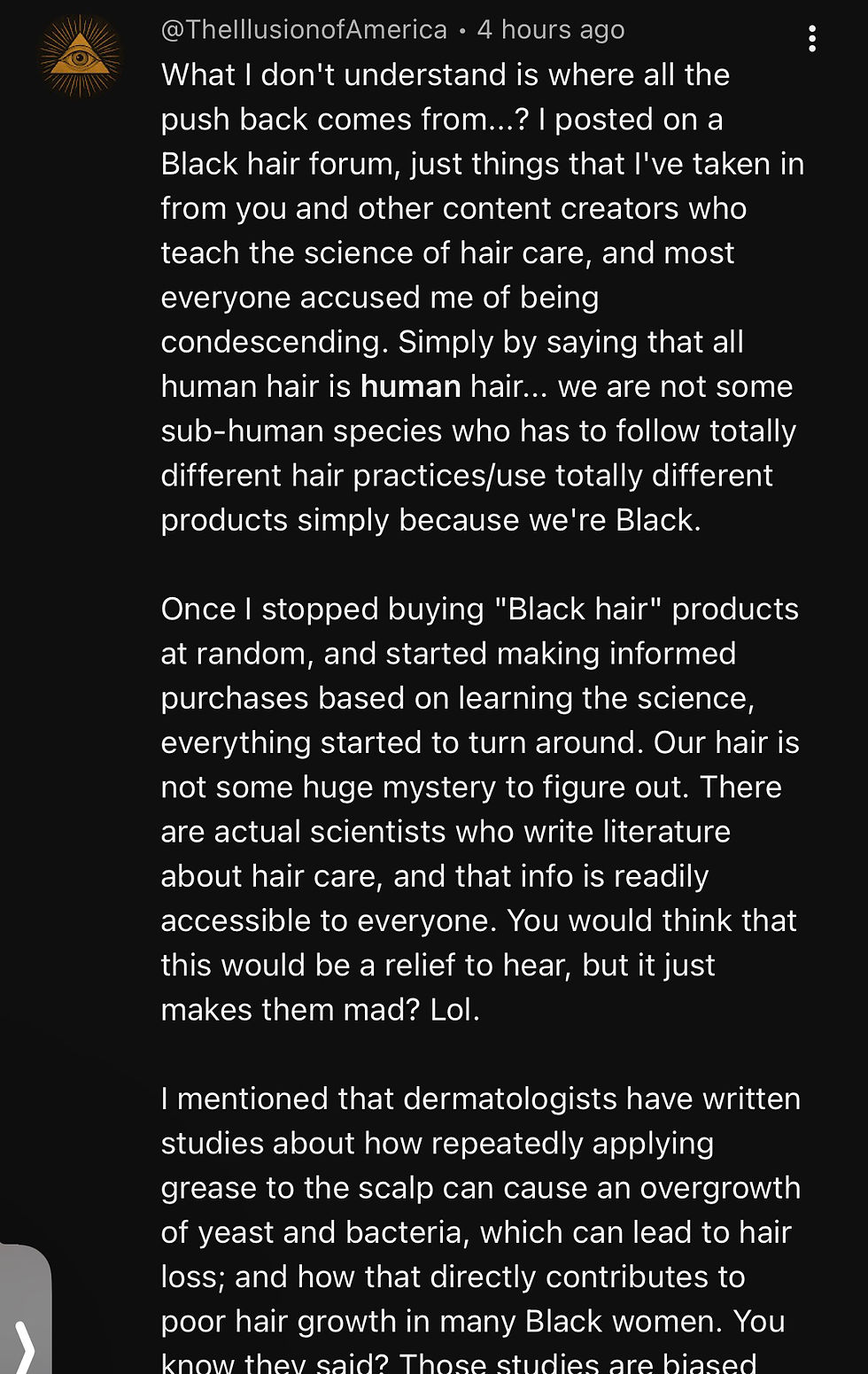

The commenter explained that she had gone into a Black hair forum and shared some of the things she had learned from me and other content creators who discuss hair care from a scientific perspective. She wasn’t attacking Black women. She wasn’t saying textured hair was inferior. She wasn’t telling anybody they needed to straighten their hair or abandon Black hairstyles. She was essentially saying that Black hair is still human hair, our scalps are still human skin, and the biological processes involved in hair growth, breakage, scalp health, and hair loss don’t suddenly stop applying because we’re Black. According to her, instead of people being relieved by that idea, she received an incredible amount of pushback. Some people accused her of being condescending, and when she mentioned scientific research, some dismissed the studies as biased or anti-Black. Her question was basically: Why does information that should theoretically make caring for our hair easier make some people so angry?
The more I thought about that question, the more I realized that I’ve witnessed the same thing repeatedly in my own comment sections. I can make what I believe is a straightforward statement about shampoo, oils, scalp buildup, hair growth, breakage, ingredients, or product marketing, and suddenly the conversation becomes much bigger than hair. People start talking about what their mothers taught them, what their grandmothers used, what Black women have been doing for generations, what worked for them personally, racism within the medical community, discrimination against Black hair, and whether scientific research can even be trusted. Before you know it, we’re no longer discussing whether a particular product does what its label claims. We’re discussing culture, identity, family, history, distrust, personal autonomy, and somebody’s entire understanding of their hair. And I think that’s an extremely important distinction, because sometimes I may be discussing hair biology, while the person receiving the information is experiencing the conversation as a challenge to something much deeper.

There is actually a psychological concept that can help us understand part of this reaction, and it’s called psychological reactance. Psychological reactance is essentially the resistance people can experience when they believe someone is threatening their freedom to think, choose, or behave the way they want. Research in health communication has examined this phenomenon for years. A meta-analysis published in Human Communication Research examined studies involving thousands of participants and found support for understanding psychological reactance through a combination of anger and negative thoughts or counterarguments. More recent meta-analytic research has continued examining how controlling or freedom threatening language can contribute to perceived threats to autonomy and resistance to health messages.
This doesn’t mean that every angry comment on the internet can be explained by psychological reactance, and it certainly doesn’t mean that somebody who disagrees with scientific information has a mental-health disorder. Reactance isn’t a diagnosis. It’s a normal psychological phenomenon that can help explain why telling someone, “You shouldn’t do this,” can sometimes make that person even more motivated to defend the behavior.
Now apply that concept to Black hair care. Imagine somebody has greased her scalp since she was five years old. Her mother greased her scalp. Her grandmother greased her mother’s scalp. She has greased her own children’s scalps. She may have decades of memories associated with that practice. Then someone on the internet appears and says, “You don’t necessarily need to grease your scalp.”
The person speaking may believe they’re making a simple statement about scalp care, but the person listening may hear something entirely different. She may hear, “Everything your mother taught you was wrong.” She may hear, “Your grandmother didn’t know how to take care of hair.” She may hear, “You have been stupid for doing this all these years.” Nobody necessarily said any of those things, but human beings don’t receive information in a vacuum. We interpret new information through our memories, experiences, identity, emotions, and existing beliefs.

Once somebody perceives the message as disrespectful or threatening to her autonomy, the conversation can quickly shift from “Is this information accurate?” to “Who are you to tell me what to do?”
That’s especially important when we’re discussing Black hair because our hair has never been merely cosmetic. Black hair carries enormous cultural and historical significance. Many of us can remember sitting between our mother’s or grandmother’s legs while getting our hair combed, braided, pressed, parted, greased, or decorated with barrettes. We remember wash day. We remember beauty supply stores. We remember hot combs sitting on the stove. We remember relaxers, braids, beads, rollers, bonnets, scarves, grease, oils, and the products that seemed to exist in every Black household. These practices aren’t simply instructions written on the back of a shampoo bottle. They’re attached to people we love. They’re attached to childhood. They’re attached to community. They’re attached to memories. So when somebody challenges one of those practices, it can accidentally feel like they’re challenging the people and experiences connected to it.
But learning that a practice may not be necessary or may not be appropriate for your particular scalp or hair doesn’t mean your mother failed you. It doesn’t mean your grandmother was ignorant. It doesn’t mean Black women didn’t know how to take care of themselves. Previous generations used the information, products, resources, and cultural knowledge available to them at the time. That’s what human beings have always done. The entire point of accumulating knowledge is that later generations get access to information earlier generations didn’t have. We do this everywhere else in life. We don’t use the exact same medical treatments we used 80 years ago simply because our grandparents used them. We don’t expect technology to remain frozen because an older version once worked. Hair care should be allowed to evolve too. Respecting the women who taught us doesn’t require us to freeze their knowledge in time.
There’s another major part of this conversation that I don’t think should be dismissed, and that’s medical mistrust among Black Americans. If a Black woman tells me she’s skeptical of medical institutions or scientific research, I’m not going to pretend that distrust came out of nowhere. There is extensive historical and scholarly literature documenting racism, discrimination, unethical treatment, exclusion, and disparities involving Black Americans and the U.S. medical system. Those experiences have consequences, and research has examined the relationship between historical experiences, discrimination, mistrust, and health-care engagement among Black Americans. So asking questions about research is not inherently ignorant. Asking who funded a study, who participated, whether Black people were adequately represented, how researchers defined their variables, whether the sample was large enough, and whether the conclusions actually apply to textured hair are perfectly reasonable questions. In fact, asking those questions is part of scientific literacy.
Where skepticism becomes problematic is when the conclusion has already been decided before the evidence is even examined. There is a major difference between saying, “Show me the study because I want to see whether Black women were represented,” and saying, “If the study disagrees with what I believe, the study must be anti-Black.” One position is asking for better evidence. The other makes the belief almost impossible to challenge because any contradictory evidence can simply be dismissed as proof of bias. Science should absolutely be criticized. Researchers can make mistakes. Studies can be poorly designed. Samples can be too small. Populations can be underrepresented. Confounding variables can be overlooked. Conclusions can be exaggerated on social media. But those limitations are reasons to examine research more carefully, not reasons to abandon evidence altogether.
And I also want to make something extremely clear whenever I say that Black hair is human hair: I am not saying that every human being has identical hair or that race, ethnicity, curl pattern, grooming practices, and hair characteristics are irrelevant. There is scientific literature specifically examining hair and scalp conditions among people of African descent, including traction alopecia, central centrifugal cicatricial alopecia, seborrheic dermatitis, breakage, chemical processing, heat styling, tight hairstyles, and other practices or conditions particularly relevant to Black patients. Hair fibers can differ in geometry, curl, diameter, fragility, and other characteristics, and different styling practices can create different types of mechanical stress. Saying Black hair follows human biology does not erase those differences. It simply means those differences still occur within human biology. Black hair isn’t a mysterious substance governed by completely separate biological rules.
This distinction matters because sometimes people hear “Black hair is human hair” and interpret it as “Black hair has no unique characteristics.” That’s not the argument. My point is that our differences don’t require us to abandon the basic principles of dermatology, chemistry, cosmetic science, and biology. Our scalps are skin. Hair follicles are biological structures. Hair fibers are primarily composed of keratin. Hair grows from follicles. Hair can break. Follicles can become affected by inflammatory and scarring conditions.
Excessive tension can damage hair and, in some circumstances, contribute to hair loss. Chemical treatments can alter hair fibers. Water, surfactants, conditioning agents, polymers, oils, heat, friction, and mechanical manipulation interact with hair in ways that can be studied. None of that takes anything away from the beauty, cultural importance, or versatility of Black hair.
I think one of the biggest benefits of approaching hair this way is that it can actually make hair care less complicated. The commenter who started this entire conversation said something I found especially interesting: once she stopped randomly purchasing products simply because they were labeled for “Black hair” and started making informed purchases based on what she was learning, her experience began to improve. That’s a conversation I desperately want more Black women to have because marketing and science are not the same thing. A company can put a beautiful Black woman with curls on a bottle. They can cover the label with words like “moisture,” “growth,” “repair,” “strengthening,” “nourishing,” and “natural.” They can add oils, herbs, extracts, butters, and whatever ingredient happens to be trending that month. None of that automatically proves the product is appropriate for your individual hair or scalp, and it certainly doesn’t prove every marketing claim printed on the bottle.

Somewhere along the way, caring for Black hair became incredibly product-heavy. We were told we needed shampoo, clarifying shampoo, co-wash, conditioner, deep conditioner, leave-in conditioner, cream, butter, oil, scalp oil, growth oil, edge treatment, protein treatment, moisturizing treatment, detangler, refresher spray, and then another product to deal with the buildup created by all the other products. I’m exaggerating a little, but not by much. There is an enormous financial incentive for the beauty industry to convince consumers that every new concern requires another bottle. And when somebody has been told her entire life that her hair is uniquely difficult, chronically dry, impossible to manage, fragile, and constantly in need of another product, she’s an extremely valuable customer. The more mysterious the problem feels, the easier it becomes to sell a miracle solution.
That’s why I keep coming back to education. Instead of asking, “What product should I buy?” I want women to start asking, “What problem am I actually trying to solve?” Those questions are not the same. If you’re experiencing breakage, that’s different from hair shedding from the root. If you’re experiencing a scalp disorder, that’s different from having hair that feels rough. If you’re experiencing traction-related damage, adding another oil doesn’t remove the tension. If you’re dealing with chemical damage to the hair fiber, a product may temporarily improve the feel or manageability of the hair, but it can’t magically return a severely damaged fiber to its original biological state. And if somebody is experiencing persistent itching, inflammation, scaling, sores, tenderness, or unexplained hair loss, that may require evaluation by a qualified dermatologist rather than another product recommendation from TikTok.
One of the habits I especially want us to question is the tendency to call almost every scalp or hair complaint “dryness.” The scalp itches? Must be dry. There are flakes? Dry scalp. Hair is breaking? Needs moisture. Hair isn’t retaining length? Needs more moisture. Scalp feels uncomfortable? Add oil. But similar-looking symptoms can have different causes, and treating every symptom with the same response doesn’t make sense. Flaking can occur for different reasons. Itching can have different causes. Hair loss can have numerous causes. Breakage can result from chemical damage, heat, friction, manipulation, tension, weathering of the fiber, and other factors. Even when two people have similar-looking symptoms, the underlying issue may not be the same. You cannot intelligently solve a problem if you’ve incorrectly identified the problem.
This is also where I think social media has made hair education both better and worse. On one hand, we have access to more information than previous generations could have imagined. You can hear dermatologists discuss scalp disorders, cosmetic chemists explain formulations, researchers discuss studies, and hairstylists demonstrate techniques without leaving your house. That’s incredible. On the other hand, social media rewards confidence, entertainment, controversy, and dramatic transformation. It doesn’t necessarily reward accuracy. “THIS OIL GREW MY HAIR THREE INCHES!” is a much more exciting video title than “There are multiple variables involved, so this individual experience cannot establish causation.” Unfortunately, the second statement is much closer to how scientific reasoning actually works.
Science is often less exciting than social media. Science says, “We don’t know yet.“
Science says, “This study suggests an association, but that doesn’t necessarily establish causation.”
Science says, “The sample was small.”
Science says, “These findings may not generalize to everyone.”
Science says, “We need replication.”
Science says, “There are several plausible explanations.”
That’s not nearly as entertaining as somebody holding up a bottle and promising that your hair will reach your waist by Christmas. But if your goal is to understand what’s actually happening to your hair, learning to tolerate uncertainty is incredibly important.
Personal testimony creates another problem because people understandably trust their own experiences.
Someone will tell me, “I know this oil grows hair because I used it and my hair grew.” I am not saying she’s lying. I believe her hair grew. What I’m questioning is whether that observation alone establishes why it grew. Human scalp hair grows naturally. During the same period, she may have changed her hairstyle, reduced heat, stopped overmanipulating her hair, experienced less breakage, improved a scalp condition, changed her diet, corrected a deficiency under medical care, stopped using a damaging chemical process, or simply became more consistent with her routine. Maybe the product contributed somehow. Maybe it didn’t. Maybe several factors changed simultaneously. A personal experience can tell us what happened to one person, but determining causation requires a much more controlled way of asking the question.
This is where another psychological idea becomes relevant: human beings naturally look for patterns and explanations. If we perform an action and then something good happens, it’s extremely tempting to connect the two. “I started using this product, and then my hair got longer, therefore this product caused my hair to grow faster.” But there may be other explanations. Perhaps the person’s growth rate didn’t change at all and she simply retained more length because she experienced less breakage. That’s a huge distinction in hair care because growth and length retention are not the same thing. A person can have perfectly normal growth at the follicle while struggling to see increased length because the ends are breaking as quickly as new length is being produced. If she changes her styling habits and breakage decreases, her hair may suddenly appear to “grow faster” even though the rate of growth at the follicle hasn’t dramatically changed.
And then we have confirmation bias, another well known concept in psychology. Broadly speaking, confirmation bias describes our tendency to seek, interpret, or remember information in ways that support beliefs we already hold. Again, this isn’t a Black-woman problem. It’s a human problem. If I strongly believe a particular oil grows hair, I’m naturally going to notice the testimonials from people saying the oil transformed their hair. I may scroll past the 100 people who say it did nothing. If I already distrust shampoo, every story about someone whose hair felt dry after shampooing can feel like proof that shampoo is damaging, while evidence that cleansing is an important part of scalp and hair care may receive much more scrutiny. The same thing can happen on the other side too. People who consider themselves “science-based” aren’t magically immune from confirmation bias. That’s precisely why good scientific methods are designed to reduce the influence of our expectations and personal beliefs.
Now combine confirmation bias with psychological reactance, cultural identity, family traditions, personal experiences, distrust of medical institutions, beauty marketing, and social media algorithms. Suddenly it makes a lot more sense why a conversation about something as simple as scalp grease can turn into a full-blown war in the comments.
Somebody may not simply be defending a jar of grease. She may feel like she’s defending her intelligence, her mother, her grandmother, her culture, her personal experience, and her right to decide what happens to her own body. That doesn’t mean the scientific claim being discussed is automatically correct, but it does explain why simply throwing another study at someone doesn’t always resolve the disagreement.
Algorithms can intensify this too. If you interact repeatedly with content supporting a particular hair philosophy, social media platforms can continue showing you similar content. Eventually, something that is genuinely debated can begin to look universally accepted because nearly everyone appearing on your feed agrees with you. Then when someone presents contradictory information, they don’t simply seem like another person with a different interpretation. They can seem completely ridiculous because you’ve been surrounded by hundreds of pieces of content reinforcing the opposite conclusion. This is another reason I encourage people to leave the comment section and look at the actual evidence whenever possible. Popularity is not the same thing as scientific consensus, and virality is definitely not peer review.
But I don’t want this conversation to turn into “science good, tradition bad.” That’s lazy, and it’s not what I believe. Traditional practices can have value. Personal experience has value. Hairstylists have practical knowledge that researchers may not possess. Cultural knowledge matters. Scientific research matters. Dermatology matters. Cosmetic chemistry matters. These sources of knowledge can sometimes complement each other. The goal shouldn’t be to humiliate people for what they were taught. The goal should be figuring out which practices are useful, which are harmless preferences, which claims are unsupported, which practices may create unnecessary problems for some people, and which symptoms warrant professional medical attention.
And I think we need to normalize one sentence more than almost anything else: “I didn’t know that.” There is nothing embarrassing about saying you didn’t know something. There is nothing embarrassing about saying, “I’ve done this for 20 years because that’s what I was taught, but I’m going to look at the newer evidence.” You don’t have to defend every decision you’ve ever made simply because you made it. You made those decisions using the information you had available at that time. When better information becomes available, you’re allowed to update your behavior. That’s not stupidity. That’s learning.
Imagine if we approached hair care with curiosity instead of defensiveness. Instead of immediately asking, “Who’s right?” we could ask, “What does the evidence actually show?” Instead of saying, “My grandmother did this, so it works,” we could say, “My grandmother did this, and I want to understand what effect it actually has on the hair and scalp.” Instead of saying, “Scientists said it, so it must be true,” we could ask, “How strong is the study? Who was included? What were the limitations? Has the finding been replicated?” That’s what healthy skepticism looks like. Healthy skepticism doesn’t automatically believe everything, but it also doesn’t automatically reject everything.
Ultimately, I don’t want Black women to feel frightened of our hair. I don’t want us believing our hair is some impossible biological mystery requiring 27 products, three oils, four butters, and a secret recipe passed down under a full moon just to keep it on our heads. Our hair can absolutely require thoughtful care, and different textures and lifestyles may benefit from different routines, but complexity shouldn’t be manufactured simply to sell us products. The more we understand basic hair biology, scalp health, breakage, grooming practices, product formulation, and the limits of cosmetic claims, the better equipped we are to make decisions without depending on whoever happens to have the most convincing TikTok that week.
I also don’t think we need to choose between being proudly Black and being scientifically curious. Those things were never opposites. We can appreciate the beauty and history of Black hair while questioning a hair-care practice. We can honor our mothers and grandmothers while acknowledging that knowledge evolves. We can recognize the legitimate historical reasons some Black Americans distrust medical institutions while still evaluating individual studies on their merits. We can demand better research involving Black women without rejecting every result we don’t like. We can value personal experiences without confusing anecdotes with controlled evidence. And we can disagree with each other without immediately deciding that somebody asking for evidence must be anti-Black.
Most importantly, we should stop treating changing our minds like losing an argument. Changing your mind because you received better evidence is not losing. If I tell you something today and stronger research tomorrow demonstrates that I was wrong, I should be willing to change what I say. That’s the standard I want for myself, and it’s the standard I think anyone presenting educational information should aspire to. The goal shouldn’t be protecting our favorite beliefs. The goal should be getting closer to the truth, even when that truth requires us to reconsider something we were completely convinced about yesterday.
So when someone asks me why conversations about Black hair science sometimes receive such intense pushback, I don’t think there’s one simple answer. I think we’re seeing a mixture of psychology, history, culture, identity, mistrust, personal experience, marketing, social media, and the normal human difficulty of changing deeply held beliefs. Understanding those factors doesn’t mean every criticism should be dismissed as somebody being “defensive.” Sometimes critics are right. Sometimes studies deserve criticism. Sometimes educators communicate poorly. Sometimes people make claims that go beyond what the evidence actually supports. The answer is not blind trust in science or blind trust in tradition. The answer is learning how to evaluate evidence.
That’s ultimately what I want for Black women: not obedience to me, not obedience to another creator, and not obedience to a beauty brand. I want women to have enough information to ask better questions.
What exactly is this product supposed to do?
What evidence supports that claim?
Am I experiencing growth problems or breakage?
Is this actually dryness, or am I assuming it’s dryness?
Is this a cosmetic concern or something a dermatologist should evaluate?
Am I continuing this practice because it benefits my hair, or simply because I’ve always done it?
If somebody presents evidence contradicting my belief, am I willing to examine it before rejecting it? And most importantly, what evidence would actually change my mind?
Because once we start asking those questions, the beauty industry has a much harder time selling us fear. Viral creators have a much harder time selling us miracles. And misinformation has a much harder time surviving simply because it’s familiar. Black women deserve hair education that respects our intelligence enough to explain the why, not just tell us what bottle to buy next. We deserve to understand our hair rather than fear it. We deserve to question information without being shamed for asking questions. And we deserve to change our minds when the evidence changes without feeling like doing so somehow betrays our culture.
At the end of the day, this isn’t really about grease. It isn’t about shampoo. It isn’t about whether Grandma was right or wrong. It’s about whether we’re willing to separate identity from evidence long enough to ask a very simple question: “Is what I’m doing actually helping me achieve the result I want?” If the answer is yes and the evidence supports it, wonderful. If the answer is no, we should be free to change course. And if we don’t know yet, it’s perfectly acceptable to say that too.
Our culture deserves respect. Our experiences deserve to be heard. Our history deserves to beacknowledged.
And our hair deserves evidence-based conversations too.
Because the goal was never to win an argument in a comment section.
The goal is to know better, choose better, and take better care of the hair and scalp we actually have.


Comments