
The Biology Behind The Verdant Code™
Why Hair Doesn't Simply Grow It Responds
By Cyn SmithFounder of Cynple Apothecary | Creator of The Verdant Code™
For generations, the conversation around hair growth has revolved around a single question:
How do I make my hair grow?
It's a question that has fueled an industry worth billions of dollars. Every year, new oils, serums, supplements, shampoos, and treatments promise thicker hair, faster growth, and miraculous transformations. Yet despite the endless products and advice, millions of people continue asking the same question because, after trying everything, they still don't understand why their hair changed in the first place.
Over the years, I found myself asking a different question.
Not "How do I grow hair?"
But rather...
"What allows a healthy hair follicle to function the way it was designed to?"
That simple shift completely changed the way I viewed hair biology.
It became the foundation of The Verdant Code™.

The Verdant Code™ is my educational framework for understanding the biological environment that supports healthy hair. It is not a medical diagnosis, nor does it claim that every form of hair loss shares the same cause. Hair loss is complex and can result from genetics, autoimmune disease, hormonal changes, nutritional deficiencies, medications, mechanical stress, aging, or other medical conditions. Instead, The Verdant Code™ organizes well-established principles of hair biology into a framework that encourages people to think beyond products alone and consider the health of the environment surrounding the follicle.
Because one thing becomes increasingly clear when studying hair biology:
Hair follicles don't simply grow. They respond.
They respond to oxygen.
They respond to nutrients.
They respond to hormones.
They respond to inflammation.
They respond to circulation.
They respond to physical tension.
Most importantly...
They respond to the environment surrounding them.

Hair Is More Than What You See
Most people think of hair as something sitting on top of the scalp.
In reality, the visible strand is only the finished product.
The real work happens beneath the skin.
Each strand begins inside a hair follicle—a remarkably complex mini-organ embedded within the dermis. While the hair shaft itself is composed of keratinized cells and is no longer living once it emerges from the skin, the follicle remains one of the body's most metabolically active structures.
Inside this microscopic organ, thousands of biological events occur every second.
Specialized matrix cells divide rapidly to create new hair fibers.
The dermal papilla sends growth-regulating signals and helps coordinate communication between surrounding tissues.
Tiny capillaries continuously deliver oxygen and nutrients.
Stem cells stored within the follicle regenerate tissue with each new growth cycle.
Sebaceous glands secrete sebum, helping protect both the scalp and hair shaft.
Nearby immune cells constantly monitor the environment, responding to injury, infection, and inflammation.
Every one of these structures depends on communication.
Every one depends on balance.
Every one depends on its environment.
This is why I often say...
Hair doesn't make decisions.
Hair responds to conditions.

The Hair Growth Cycle: A Biological Rhythm
Unlike many tissues in the human body, hair does not grow continuously.
Instead, every follicle follows a repeating biological rhythm known as the hair cycle.
During the anagen phase, the follicle enters active growth. Matrix cells divide rapidly, producing the hair shaft. For scalp hair, this phase may last anywhere from two to seven years, largely determining the maximum length a person can grow their hair.¹
Eventually, the follicle enters catagen, a short transition period lasting several weeks. Cell division slows, the follicle begins to shrink, and communication with the dermal papilla changes.
Next comes telogen, often called the resting phase. Although the hair remains anchored in the scalp, it is no longer actively growing.
Finally, during exogen, the hair is naturally released, making room for a new anagen cycle to begin.
This process repeats thousands of times throughout a person's lifetime.
The challenge begins when follicles spend less time in anagen, struggle to re-enter the growth phase, or produce progressively finer hairs over successive cycles.
Understanding this cycle is one of the first steps toward understanding why different forms of hair thinning develop over time.
The Scalp Is a Living Ecosystem
One of the greatest misconceptions in hair care is treating the scalp as little more than skin.
Biologically, it is far more complex.
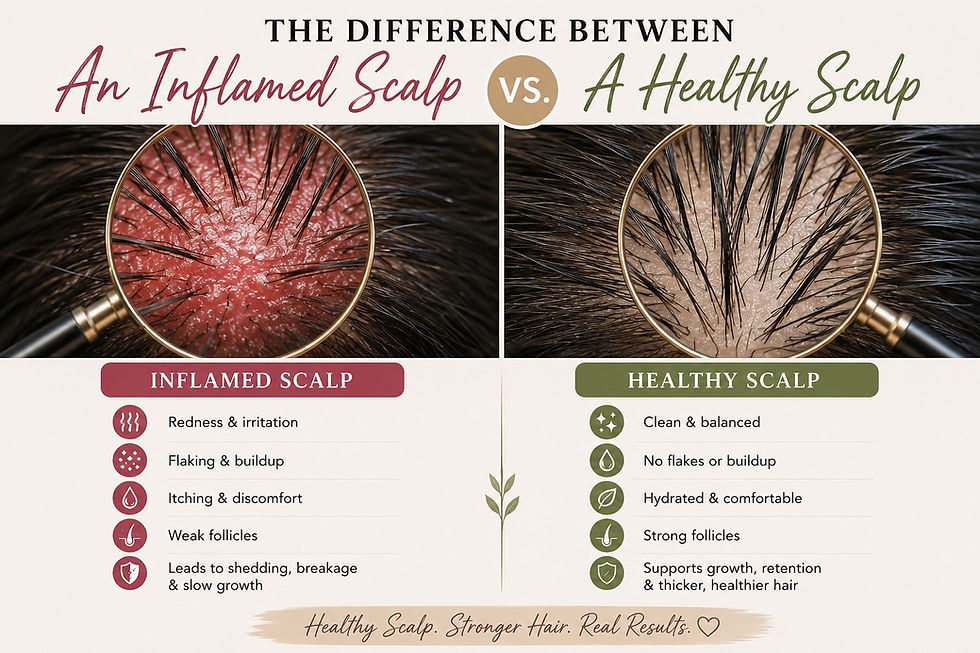
The scalp functions as a living ecosystem where every follicle exists alongside blood vessels, sweat glands, sebaceous glands, connective tissue, collagen, elastin, nerve endings, immune cells, and a diverse community of microorganisms collectively known as the skin microbiome.

Healthy ecosystems depend on balance.
Forests flourish because countless organisms work together.
Healthy soil supports healthy roots.
Healthy roots support healthy trees.
The same principle inspired the name The Verdant Code™.
The word verdant means green, flourishing, fertile, and full of life.
Nature rarely forces growth.
It creates the conditions where growth becomes possible.
That simple observation changed how I think about hair.
Instead of asking...
"How do I force hair to grow?"
I now ask...
"How do I support the healthiest possible environment for the follicle to function the way it was designed?"
Everything within The Verdant Code™ begins with that question.
Scientific References & Further Reading
Sinclair R. Hair Cycling and Hair Loss. Journal of Investigative Dermatology Symposium Proceedings.
Paus R, Cotsarelis G. The Biology of Hair Follicles. New England Journal of Medicine.
Stenn KS, Paus R. Controls of Hair Follicle Cycling. Physiological Reviews.
Almohanna HM, et al. The Role of Vitamins and Minerals in Hair Loss. Dermatology and Therapy.
Messenger AG, Sinclair RD. Follicular Disorders. Rook's Textbook of Dermatology.
American Academy of Dermatology Association. Hair loss resources and patient education.


Comments