
The Hair Grease Myth: Why Your Scalp Was Never Designed to Be Covered in Petrolatum
Updated: Jul 16
Separating science from tradition with evidence from dermatology, skin physiology, and hair biology.

For generations, many people have been taught that greasing the scalp is essential for healthy hair growth. Heavy hair grease—typically formulated with petrolatum (petroleum jelly), mineral oil, and waxes—became a cultural staple long before we understood scalp biology.
Today, dermatology paints a much different picture.
This article isn’t about demonizing hair grease. It’s about understanding what it actually does, what it doesn’t do, and why petroleum and petrolatum are not the same thing, despite often being confused.
Myth #1: Petroleum and Petrolatum Are the Same Thing

This is scientifically incorrect.
Although the names sound similar, they refer to two very different materials.
Petroleum
Petroleum (crude oil) is an unrefined naturally occurring mixture containing thousands of hydrocarbons plus sulfur compounds, nitrogen compounds, metals, and numerous impurities.
It is the raw material removed from the earth.
Petrolatum
Petrolatum (petroleum jelly) is a highly refined derivative produced during petroleum refining.
During processing:
impurities are removed
carcinogenic compounds are removed for cosmetic/pharmaceutical grades
consistency becomes standardized
only selected high-molecular-weight hydrocarbons remain
Think of it like this:
Petroleum = crude oil
Gasoline = refined product
Diesel = refined product
Asphalt = refined product
Petrolatum = refined product
They’re related—but they are not chemically identical.

What Does Petrolatum Actually Do?
This is where most misinformation begins.
Petrolatum does not moisturize skin.
It does not:
hydrate tissue
nourish follicles
feed hair
stimulate hair growth
replace natural scalp oils
Instead, it functions almost entirely as an occlusive agent.
That means it creates a physical barrier over the skin.
Dermatology literature consistently describes petrolatum as the gold standard occlusive because it dramatically reduces transepidermal water loss (TEWL)the normal evaporation of water from the skin.
Studies estimate it can reduce TEWL by more than 98%.
Notice what that means.
It keeps existing water from escaping.
It does not create moisture.
Moisture vs. Occlusion
These words are often used interchangeably—but scientifically they are completely different.
Moisture
Water inside the skin.
Hydration
The amount of water present within the outer skin layers.
Occlusion
Creating a barrier that slows water evaporation.
Petrolatum performs only the third function.
Imagine wrapping plastic wrap around a damp sponge.
The sponge doesn’t gain water.
It simply loses water more slowly.
That’s exactly how petrolatum works.

Your Scalp Already Has Its Own Moisturizing System
The scalp isn’t dependent on grease.
Nature already solved that problem.
Every healthy scalp contains sebaceous glands attached to hair follicles.
These glands continuously produce sebum.
Sebum is a complex mixture of:
triglycerides
wax esters
squalene
free fatty acids
Its job is to:
lubricate the scalp
reduce water loss
protect against environmental damage
coat the hair shaft
This system has existed for millions of years.
Your scalp was literally designed to oil itself.
Why Hair Grease Doesn’t Replace Sebum
Sebum isn’t just “oil.”
It is a biologically active secretion specifically produced for human skin.
Petrolatum is simply an inert mixture of refined hydrocarbons.
One is alive.
One is manufactured.
One interacts naturally with the skin ecosystem.
The other sits on top of it.
This is why dermatologists classify petrolatum as an occlusive protectant, not a biological replacement for sebum.
What Happens When You Coat the Scalp?
Once grease is applied, several things occur.
1. An artificial barrier forms
Instead of allowing the scalp surface to remain open, petrolatum coats it.
This barrier is why the scalp often feels greasy for days.
2. Buildup begins accumulating
Grease mixes with:
dead skin cells
sweat
environmental debris
styling products
natural sebum
This creates layers of residue that require shampoo to remove.
Grease itself isn’t “dirty.”
But it becomes an adhesive for everything else.
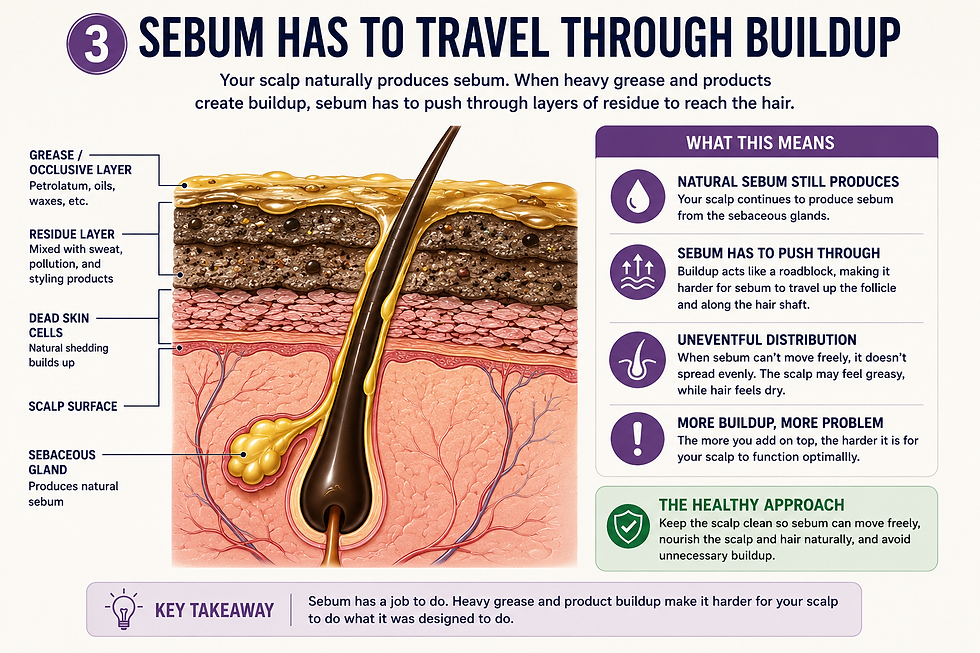
3. Natural sebum has to travel through buildup
Sebum naturally moves from follicles along the hair shaft.
Heavy residue can interfere with how evenly it spreads, contributing to a scalp that feels coated while the hair still feels dry.
It’s more accurate to say grease can contribute to buildup around follicle openings than to say it universally “blocks pores.”
Why Does Hair Feel Dry Even When It’s Greasy?
This is one of the biggest misconceptions.
People often assume:
Hair feels dry.
↓
Apply grease.
↓
Hair feels softer.
↓
Grease moisturized the hair.
But that’s not what happened.
Instead:
Hair was already dry.
Grease coated the outside.
The coating reduced friction.
Hair felt softer.
The internal moisture content barely changed.
This is why many people find themselves repeatedly reapplying grease without solving the underlying dryness.
Can Grease Clog Hair Follicles?
This question requires nuance.
Current evidence does not support saying that petrolatum universally clogs follicles or pores. In fact, cosmetic-grade petrolatum is generally considered non-comedogenic on facial skin.
However, on the scalp, where there is dense hair, continuous sebum production, sweat, and styling products, heavy occlusive layers can contribute to residue and buildup around follicle openings if not regularly cleansed. That buildup may make the scalp environment less optimal, especially in people prone to dandruff or inflammatory scalp conditions.
When Does Petrolatum Actually Make Sense?
Ironically…
Petrolatum is an excellent ingredient.
Just not necessarily for routine scalp coating.
Dermatologists routinely recommend it for:
cracked skin
wound healing
post-procedure protection
eczema
severely dry skin
protecting compromised skin barriers
In these situations, creating an occlusive barrier is exactly what’s needed.

So What Belongs on the Scalp?
For a healthy scalp without a diagnosed condition, the primary focus should be:
regular cleansing with an appropriate shampoo to remove excess sebum, sweat, dead skin, and product residue
maintaining the scalp’s natural barrier
avoiding unnecessary buildup
If a scalp condition exists—such as dandruff, psoriasis, eczema, or a bacterial or fungal infection—treatment should target the specific condition with ingredients that have been shown to work, rather than simply coating the scalp with grease. Those treatments may include antifungal shampoos, anti-inflammatory medications, or other therapies recommended by a healthcare professional.
The science leads to a balanced conclusion:
Petroleum and petrolatum are not the same substance.
Petrolatum is a highly refined derivative of petroleum.
Petrolatum is one of the most effective occlusive agents known.
Occlusion reduces water loss—it does not create moisture.
The scalp already has a natural moisturizing system through sebum production.
Routine heavy application of hair grease can contribute to buildup and does not replace the biological functions of a healthy scalp.
Hair grease may make hair feel softer because it coats the surface, but feeling moisturized and actually being hydrated are not the same thing. Understanding that distinction is key to making informed decisions about scalp care.
References
Ghadially R, et al. Effects of petrolatum on stratum corneum structure and function. Journal of the American Academy of Dermatology (1992).
Kamrani P, et al. Petroleum jelly: A comprehensive review of its history, uses, and myths. Journal of the American Academy of Dermatology (2024).
Purnamawati S, et al. The Role of Moisturizers in Addressing Various Kinds of Dermatitis. Clinical Medicine & Research (2017).
Sethi A, et al. Moisturizers: The Slippery Road. Indian Journal of Dermatology (2016).
Hamishehkar H, et al. A Comparative Histological Study on Skin Occlusion. (2015).
Ordoñez-Toro A, et al. The Assessment of Skin Homeostasis Changes after Using Different Excipients. (2022).


Comments